Latest update May 16th, 2026 12:07 AM


A kingdom of corruption
Kaieteur News – There is something oddly comic, and at the same time tragic, about the post-colonial state. It is the sort of place where ideas arrive before institutions. It is where the most industrious men are not those who build bridges or till the soil, but those who can fill out forms in triplicate and place them on the correct desk of a man who wears a tie but understands nothing.
In such places, corruption is not so much a deviation from the norm as it is the only remaining lever of functionality. Nothing moves unless grease is applied. And corruption is the grease for an engine long rusted, and the only way anything moves forward.
This, of course, was not supposed to be the way. When the colonial flags came down and the anthems changed, there was a brief period of euphoria. But the real business of running a country—of building a nation from scratch—was left to men who had, in the main, never run so much as a cakeshop.
The colonizer’s institutions were retained wholesale—Parliament, the Judiciary, the Civil Service—but the soul of these institutions had stayed behind in London or Lisbon. What remained were the exoskeletons: impressive in shape, but hollow and brittle.
In Guyana, as in other post-colonial territories, bureaucracy became an instrument of paralysis. To build a house required permits that took six months, a cousin in the city council, and often a “small gift” for someone who could nudge the paper along. To get a passport meant knowing someone whose sister had once worked at the Passport Office was needed. And to secure a government contract? That required not competence, not value for money, but proximity to power. In this world, corruption was not the enemy of development—it was the stimulus.
To be corrupt in such a system is not always to be evil. Often, it is simply to be efficient. A man who wishes to get something done must “work the system,” and working the system means understanding where the envelopes go, who gets the phone call, which relative of which minister needs a little consideration. In such a setting, it is not virtue that moves a nation—it is access.
But this is not merely an accident. Corruption, in post-colonial societies, is structural. It arises from the fundamental contradiction of the post-colonial project: the attempt to graft imported institutions onto societies that did not organically evolve them. There is no deep-rooted trust in these institutions because they were never truly ours. They were things we inherited. So, we learn to manipulate them, not to build them. We survive despite them, not through them.
In Guyana, successive governments—left, right, and centre—have been felled or hobbled by corruption. And yet, every five years, they come to the people with fresh promises: “This time, we will strengthen institutions. We will digitize services. We will make procurement transparent.” And the donor agencies nod approvingly. But the reality is that these same institutions are staffed by men and women whose careers have been built on knowing how to stall or shuffle or obscure. Improving institutions, in such a context, is like repainting a termite-infested house.
The real answer is more radical—and more dangerous. It is to downsize the state.
The post-colonial state is too big, too bloated, and too busy pretending to do things it cannot do. It tries to build roads, manage utilities, run hospitals, distribute scholarships, and deliver security. It wants to be saviour and employer, watchdog and welfare giver. But it cannot. What it becomes instead is a kingdom of petty princes—each with their fiefdoms, each collecting rents, each making themselves indispensable by ensuring nothing ever works unless they say so.
The more government tries to do, the more opportunities for graft it creates. Every new agency, every new programme, becomes a feeding trough. Contracts become rewards, jobs become bribes, and inefficiency becomes a virtue—because the longer something takes, the more palms that must be greased. To downsize government, then, is not to destroy the state. It is to save it from itself.
But therein lies the rub. The very people who must decide to shrink the state are the ones most dependent on its bloat. Their power is derived not from their intellect or achievement, but from the ministries they control and the budgets they command. To downsize government would be to dismantle their kingdoms. And so, with tragic circularity, the corrupted are tasked with curing corruption, and the result is predictable: inquiries that go nowhere, audits that find “procedural gaps,” and reports that gather dust.
And yet, without this radical surgery, Guyana—and much of the post-colonial world—will remain trapped in a theatre of governance, where appearances matter more than results, and where corruption continues to be not merely a vice, but a necessity. The tragedy is not that corruption exists. The tragedy is that it works.
And so, the circus rolls on. The ministers give speeches, the bureaucrats hold workshops, the newspapers write editorials. But in the quiet corners of the capital, in the air-conditioned rooms behind the ministries, the real business of the state continues—in whispers, in favours, in envelopes. This is the true economy of the post-colonial state: not production or innovation, but access.
It is a kingdom, yes. But one built not on merit or service, but on the delicate, cynical art of getting things done through the application of a little grease.
(The views expressed in this article are those of the author and do not necessarily reflect the opinions of this newspaper.)
Share this:

Discover more from Kaieteur News
Subscribe to get the latest posts sent to your email.
Similar Articles
One thought on “A kingdom of corruption”

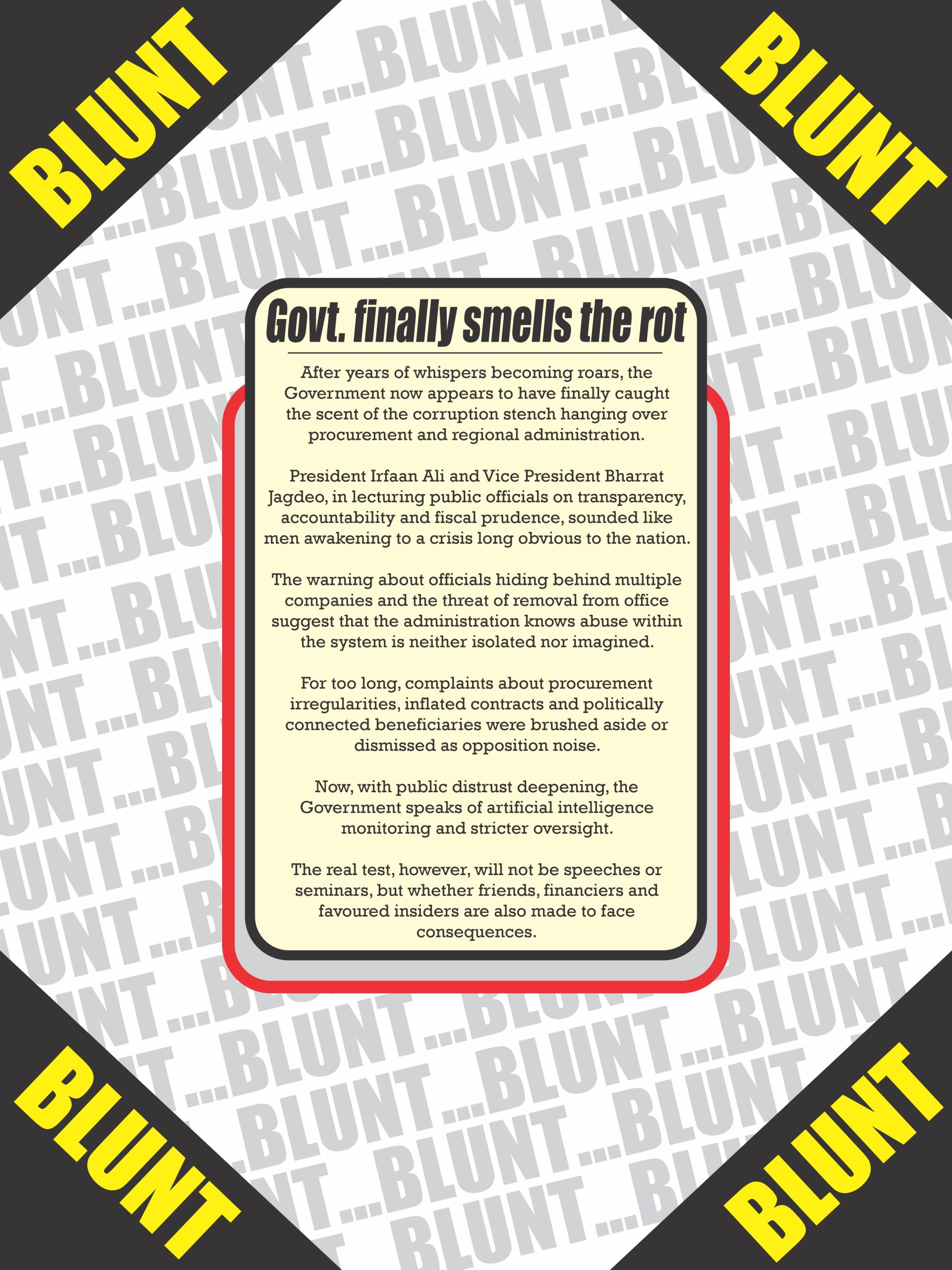
THE BLUNT OF THE DAY
Sports

Features/Columnists

Sir. Ronald Sanders

The GHK Lall Column

Weekend Cartoon



I wanted to give thanks for this almost sweet, whimsical editorial on
post Colonial. piece ” The Kingdom of corruption.” very Royal, and appropriate truth that was in play I am sure with no lack of innocents well before Independence
and has been rolling over since. in other times was known as “On the fiddle”.