Latest update October 18th, 2026 10:40 AM



Raise the bar in our public discourse
Kaieteur News – With elections due next year the political temperature has arisen in this country and so too is the uncouth manner in which some of our leaders relate to each other and the public at large. Only recently a senior member of a political party was called a ‘low life’. Followers of opposition parties are branded as insane and other derogatory names. These are words spoken by very senior public officials who will soon seek the votes of citizens.
The lack of civility in our society has reached a point where reporters of this newspaper have had to steel themselves to deal with the uncouth, disrespectful and crass display every week by politicians. When as society our leaders can be so bitter then this is a cause for serious concern. We certainly have the right to hold convictions and take strong stands on important issues, but there is a right way to state right positions. Our leaders must be reminded that they must always be prepared to give an answer to everyone even if the question is unsettling and do so with gentleness and respect. Civility involves disagreeing with dignity as well as dignifying those with whom we disagree.
There are actually three facets to civility: civility as respect for others, civility as public behaviour and civility as self-regulation. The first element insists that civility involves a demonstration of respect for others. As a young man, George Washington, father of the American Republic set down his ‘110 Rules of Civility and Decent Behaviour in Company and Conversation’. His first rule was: ‘Every action done in company ought to be with some sign of respect to those that are present.’
This emphasis on respecting others is still the core of the idea of civility today. Civility provides a universal tool for signalling respect for others: the significance is in the symbolism of the act more than the result of the behaviour.
The second element suggests that civility requires us to show respect to strangers and this requirement invests it with a strong moral quality. Concern shown to friends and family may arise from empathy or love, and it is likely to be strengthened by the certainty that we shall have to interrelate with them again in the future.
Civility towards strangers, however, requires that we behave in certain ways towards people who may mean nothing to us, and whom we are unlikely ever to encounter again.
This “Good Samaritan” ethic implies that civility is not restricted to a concern or sympathy towards specific others, but is rather the product of a generalised empathy and sense of responsibility that we feel with all who share our society.
The final constituent of civility is what one expert calls ‘sacrifice’, or what we might more mundanely refer to as “self-regulation”. Civility involves trimming one’s immediate self-interest—we desist from doing what would be most pleasing to us for the sake of harmonious relations with strangers. Civility means doing the right thing.
In a holistic sense then, civility is behaviour in public which expresses respect for others and which requires restraining one’s own immediate self-interest when appropriate. Would we not all agree that this quality is very much needed in our society to begin the process of forming “one people”?
The bottom line is that civility, by definition, is inherently a good: ‘It is morally better to be civil than uncivil.’ Being civil towards others is part of being a good and moral person. It indicates to our fellow citizens that one is willing to follow common rules and not act in a manner that subverts their well-being. This practice has to assist social cooperation.
The sociologist Edward Shils notes that civility is a social good because ‘there is not enough good nature or temperamental amiability in any society to permit it to dispense with good manners…Good manners repress the expression of ill nature.’
In other words, people have to be civil to each other if social life is to function harmoniously and with a minimum of unnecessary conflict and upheaval. Lastly, civility is the favoured alternative to increased State coercion. John Rawls argues that if ‘liberties are left unrestricted they collide with one another’. This is inherently true since diverse individuals will always want and desire different and incompatible things and their unencumbered pursuit of their own objectives will unavoidably lead them into conflict.
This raises the question as to how (as well as how far) individual liberties are to be constrained. Ultimately, this will either be achieved by the State apparatus, or through enlightened self-regulation.
As Edmund Burke recognised back in 1791: ‘Men are qualified for civil liberty in exact proportion to their own disposition to put moral chains upon their own appetites.”
Let us return civility to Guyana.
Share this:

Discover more from Kaieteur News
Subscribe to get the latest posts sent to your email.
Similar Articles
Website Hits

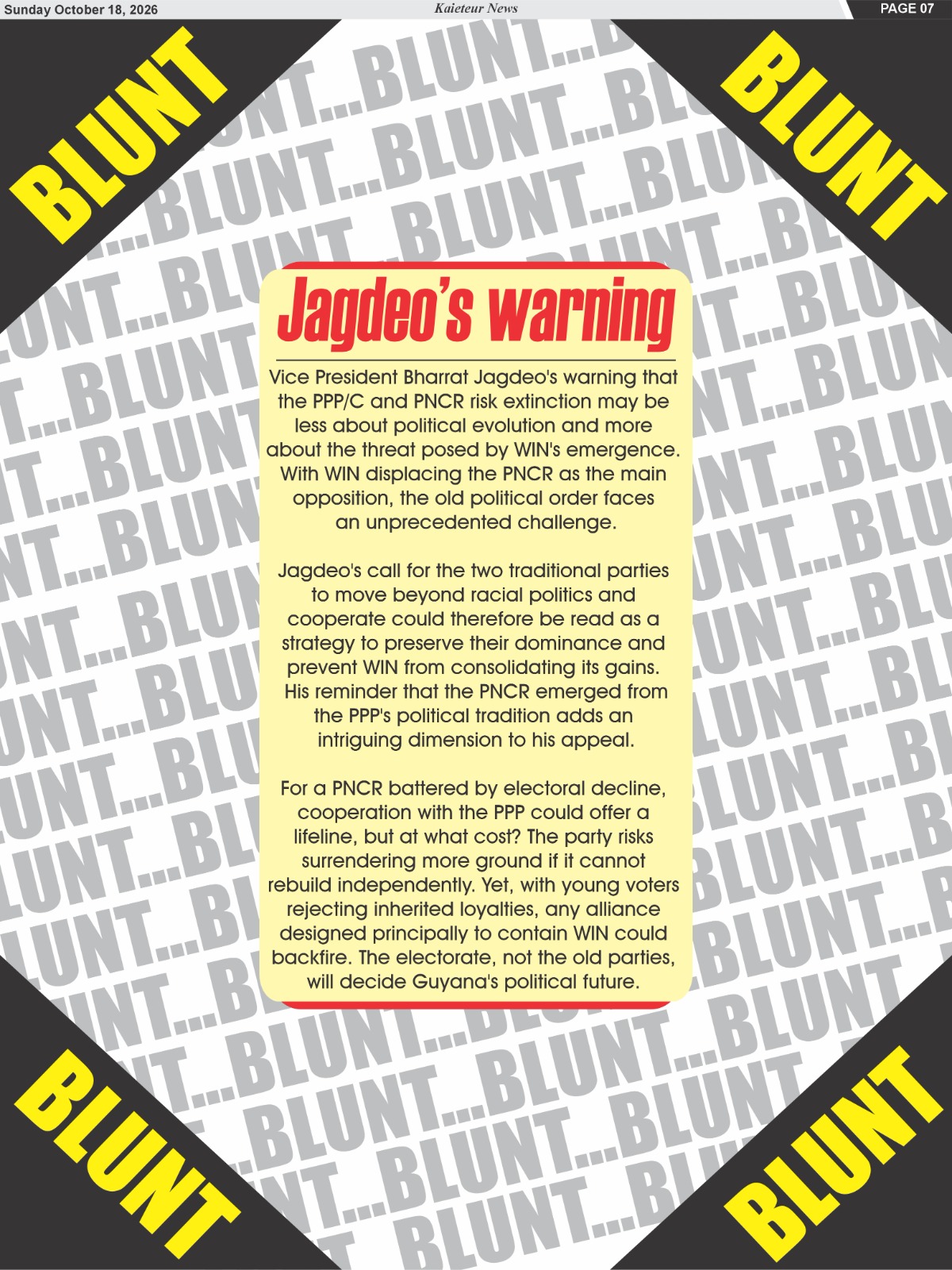
Blunt of the day
Sports

Features/Columnists

Sir. Ronald Sanders

The GHK Lall Column

Weekend Cartoon


