Latest update October 18th, 2026 6:15 AM



Latest News
- Feasibility, EIA studies must be done for all project funded by US EXIM Bank – Ambassador
- Mohamed, staff granted $750,000 bail each for firearm, obstruction charges
- EU rallies in support of Ukraine amid Trump standoff
- Subcontractor electrocuted by live GPL wire
- Rodrigues-Birkett pushes multilateralism as path to ending global conflict
‘Food on the Table’ or Constitutional Reform?
Dear Editor,
Guyanese have divergent views on constitutional reform. There are those Guyanese who advocate for additional constitutional reform beyond the 2000s amendments that were incorporated into the revised 1980 constitution; while others are baffled as to what specific articles/provisions they want to alter or add.
The latter group prefers to focus instead on “food on the table” issues, including inflation and how, in combination with the COVID-19 pandemic, these factors are heightening their social and health distress. It was the five-month March 2, 2020, election fiasco when a glaring attempt to stage an electoral coup d’état— which nearly culminated in anarchy—that provided an impetus for constitutional reform. Some people believe that the post-election turmoil had its root in the constitution, while others disagree; they locate it in the inordinate obsession with power by opposition forces.
While the existing constitution (with 2000s amendments) is not perfect, it has many admirable features, like separation of power, the rule of law, multiple ‘rights’ commissions, numerous individual rights, among others. However, if there is no enforcement mechanism in place, what sense does it make to alter or add more articles/provisions to accentuate the situation? Would ‘compliance’ drive the constitutional process? A substantial segment of the population does not necessarily have any major problem with the existing constitution but they do have deep misgivings about the lack of constitutional compliance with accompanying penalties.
Having signed onto constitutional reform, the PPP/C government is forcefully confronted with the historical reality of top government officials’ and politicians’ unwillingness to adhere to constitutional provisions and the rule of law.
The importance of compliance is exemplified by the PNC/R-led coalition’s rejection of the Carter-Price formula (that worked well for over 23 years) for the appointment of the GECOM Chair. Again, the PNC/R-led coalition refused to step down from office consequent to the successful passage of the No Confidence Motion against their government in December 2018, as per Article 106 (6).
The UWI professors are correct when they say that many administrative matters are wrongly sent to the High Courts for adjudication.
These matters are supposed to be settled at the executive level.
This shift highlights a dilemma of the political actors and their reluctance to respect/observe the rule of law. The transformation of attitudes is therefore paramount to ensure compliance. One cannot make old habits the foundation of a new social order, any more than those old ways brought the new order into existence.
I believe that the PPP/C is more inclined towards “inclusivity” than to “power sharing.” It’s existing ideology, which is not doctrinaire but organic, is aligned to inclusivity as well as to the constitution. With support from the PNC/R, the PPP/C has passed several inclusive constitutional measures such as the Rights Commissions, instituted a new system of Parliamentary management with the establishment of Parliamentary Sectoral Committees allowing for opposition leadership and reduced the powers of the Presidency.
Whenever the constitutional process is set in motion, the following items are recommended for consideration: (i) focus on compliance and penalties; (ii) clarify ambiguities (e.g., how are the procedures for changing “entrenched” provisions different from those that are not entrenched [Ref: Article 164 (1) (2)] and what does “create a republican community” mean (in Preamble); (iii) delete superfluous/conflicting language like Guyana is “in the course of transition from capitalism to socialism” (Article 1); and (iv) limit the number of Vice President to just one (ref: Article 102.
Some people view “power sharing” as central to constitutional reform and contend that if implemented, it could mitigate or eliminate ethnic tension and social upheaval. While this is an attractive theoretical construct, it is doubtful it would match reality. A major inhibiting force is the elusive ‘trust’ factor. In addition, it would undermine the very foundation of political competition for state power.
Smart people will not take the easy way out.
They would work hard to win state power through mobilisation, advocacy, and connecting with the people with appropriate policies and programmes.
It is noted that Trinidad & Tobago has a similar history and demographic structure like Guyana, yet power sharing is not central to its political landscape? In Guyana, power is already shared by opposition forces at every layer of government, except at the executive (Cabinet) level.
There is no barrier for opposition forces to acquire executive power (Cabinet) again if they push forth with a sharp vision, smart programmes and policies, and simultaneously reject violence, intimidatory tactics, and caustic rhetoric.
In my opinion, constitutional reform is likely to be overshadowed by potent factors like “inclusivity” and “food on the table” issues, including rising prices.
Dr. Tara Singh
Share this:

Discover more from Kaieteur News
Subscribe to get the latest posts sent to your email.
Similar Articles
Website Hits

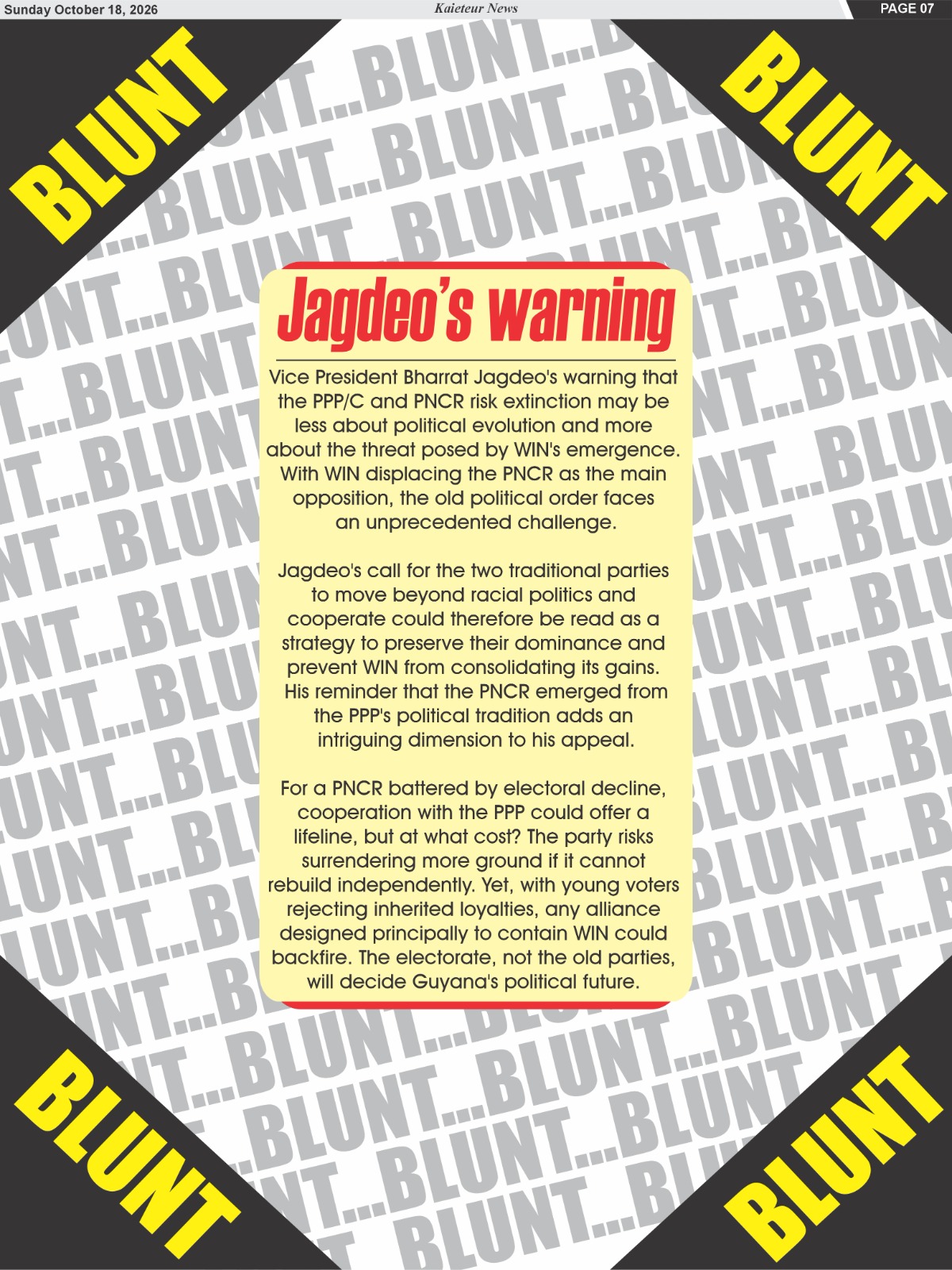
Blunt of the day
Sports

Features/Columnists

Sir. Ronald Sanders

The GHK Lall Column

Weekend Cartoon


