Latest update September 4th, 2026 10:24 AM


ExxonMobil said it will not recover US$30 flaring charge –EPA
Kaieteur News- The Environmental Protection Agency (EPA) clarified yesterday that ExxonMobil’s subsidiary, Esso Exploration and Production Guyana Limited (EEPGL), will not be recovering the US$30 per tonne charge, which it will be made to pay for flaring of Carbon Dioxide equivalent (CO2e) beyond May 13, 2020.
The regulator said this much was indicated by ExxonMobil during discussions that were recently had on modifications to the Environmental Permit for the Liza Phase One Operations.
The statement by the agency comes on the heels of an article, which Kaieteur News carried on Sunday, which exposed that the Stabilization Clause of the Stabroek Block Production Sharing Agreement (PSA) states unequivocally that if the government imposed any new charge, tax or levy of any kind after the deal was signed in 2016, then the company shall be compensated by the government.

Flaring taking place on the Liza Destiny FPSO.
Given that ExxonMobil has said it will overlook this provision for Guyana’s sake, the EPA said it therefore views the modification not as creating any additional adverse effects, but as a means of implementing more specific flare management conditions that are consistent with industry practice in order to regulate and/or deter periods of flaring.
The EPA also clarified the modification of the permit, which says that the US$30 charge will be imposed on ExxonMobil’s subsidiary after certain flaring timelines are passed for commissioning and start up. According to the permit, commissioning is defined as the process of ensuring that all systems and components are designed, installed, tested, operated and maintained according to operational requirements or manufacturer’s specifications. Start-up is defined as the activity that occurs at the end of commissioning.
With the foregoing in mind, the EPA said the timelines prescribed by the modified permit are consistent with the United States Code for Federal Regulations, which establishes that flaring may not exceed 48 hours without seeking approval. The EPA also pointed out that international benchmarking shows that the initial start-up period averages approximately 90 days. However, the modified permit specifies a more conservative start-up period of 60 days, which the EPA boasts is below the average international benchmark. It said this is also consistent with the recently issued Payara Environmental Permit.
“Any flaring in excess of these timelines requires the company to pay for the emission of Carbon Dioxide equivalent (CO2e) at the rate of US$30 per tonne of CO2e…Consequently, the EPA utilised carbon pricing benchmarking to determine this payment, so that the monies acquired from the pollution events could be used for Supplemental Environmental Projects (SEPs),” the EPA said.
Expounding on other key amendments the regulator said, “Prior to its modification, the Permit prohibited ‘Routine Flaring.’ However, process upsets, equipment failures and maintenance events are not considered ‘Routine Flaring’ in the Oil and Gas Industry. Such events were not specifically addressed or regulated in any way by the original Permit.”
Further to this, the EPA said that the original permit only required EEPGL to notify the EPA for flaring sustaining a volume of at least10 million cubic feet of gas lasting at least five (5) days. It noted however that the modified Permit now includes specific timelines for detailed instances of flaring, and notification and approval processes, during which the company must justify its reason(s) for flaring. The EPA stressed that it reserves the right to reject this request if unjustified.
In conclusion, the EPA sought to note that when it comes to oil operations, or more particularly, oil production offshore, some amount of flaring is to be expected for maintenance events, process upsets and equipment failures.
Be that as it may, the EPA said it will continue to work assiduously towards national standards which specifically address flaring. Following the modification of the Liza Phase One Permit, the EPA said it has commenced the process of developing specific flaring targets for the upcoming renewal of the said permit come June 1, as well as other upcoming EEPGL projects offshore Guyana.
Share this:

Discover more from Kaieteur News
Subscribe to get the latest posts sent to your email.
Similar Articles
Website Hits

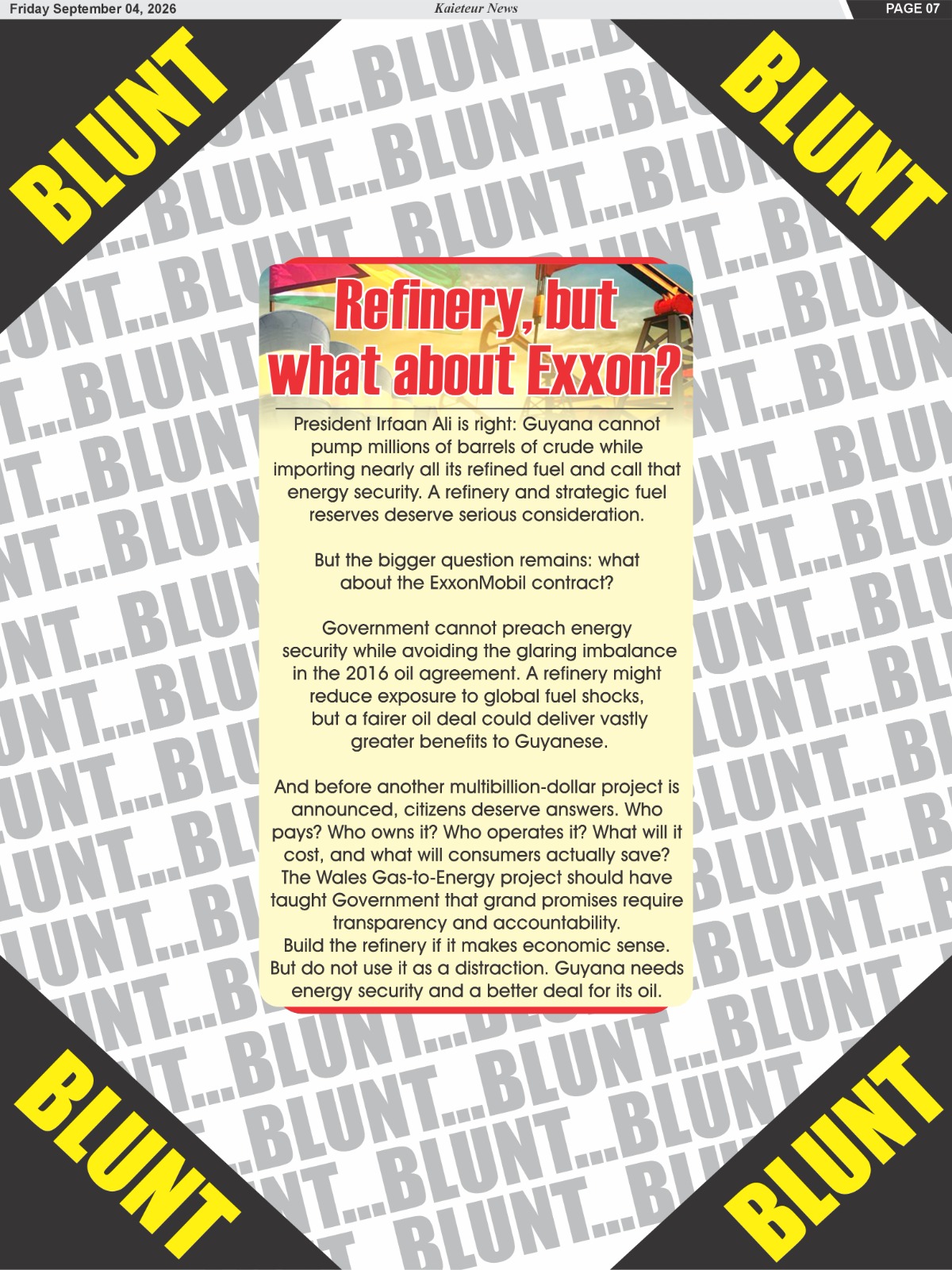
Blunt of the day
Sports

Features/Columnists

Sir. Ronald Sanders

The GHK Lall Column

Weekend Cartoon


