Latest update August 8th, 2026 12:30 AM



Latest News
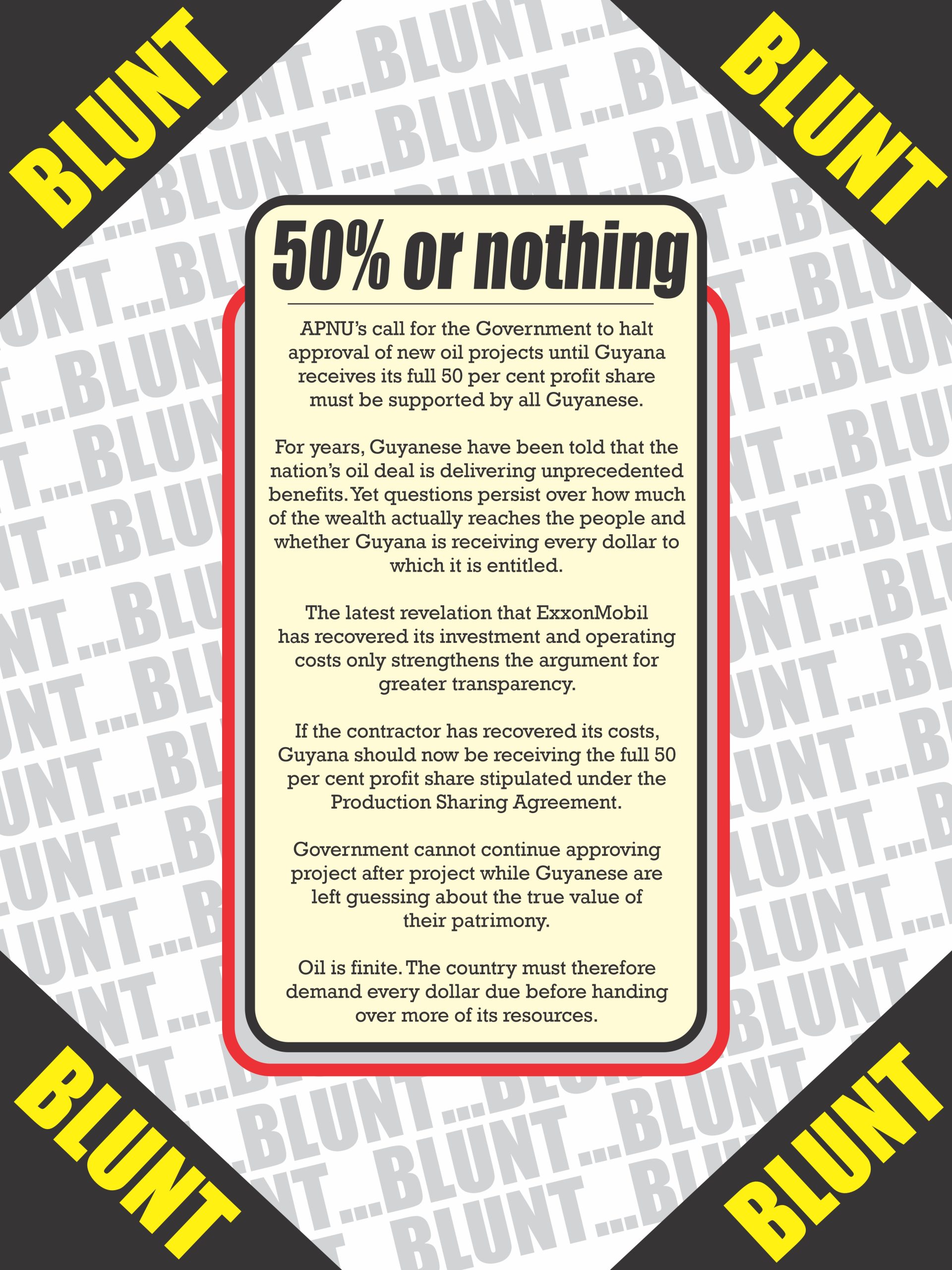
- ‘No new oil projects until Guyana gets full 50% profits’ – APNU tells Govt.
- Two dead in Water Street brawl
- “We will follow you wherever you go” – opposition vows to beef up protests against government
- Trump says war ‘can’t go much longer’
- Guyana’s oil helps cushion impacts from Middle East disruption – Exxon
Foreign companies in Guyana have their cakes and eat them too
DEAR EDITOR,
We are officially an oil-producing nation. Kudos to all our policymakers for making this a reality.
We as a nation are on the cusp of witnessing a massive economic and social transformation if we play our cards correctly. But did we receive the best deal for our resource? And what about our local businessmen? Are they competing on a level playing field against other foreign companies?
Before I answer these questions, please let me briefly reflect on what we have consented to.
First, there is no doubt whatsoever that our agreement with the oil companies has been extremely genuine in favour of the latter. We accepted a 2% royalty when the international average is 10%. Now, this is quite interesting, since royalty is the first deduction from gross revenue. Not to mention, this is presumably the only and main progressive element of revenue generation for the host country.
In other words, higher oil prices equal more revenue and vice versa. Also, since this is the first set of payments, a relatively stable revenue stream for the host country becomes more than likely. In the world of the resource curse, a smooth revenue flow is very important. Oftentimes, revenue volatility has been cited as one of the main culprits behind economic slowdown and even downfall. Of course, stabilisation funds also play an important role, but the fact remains that, relatively large cyclical upswings in revenue could potentially erode the role of these stabilisation funds.
In Guyana’s case, an embankment on a barrage of public spending could place jobs of public servants in limbo during a downturn in oil prices followed by major cuts to key social programs.
Second, on the legal side, the provisions set out in the contract, especially with Exxon et al, essentially insulate these foreign companies against any legislative change that could potentially have some sort of negative effect on their financial wellbeing.
For example, if the government decides to increase corporate tax or introduce some sort of new tax measure, these companies would not be affected. Such protection is explicitly set out under the stabilisation clause of these contracts.
Furthermore, though there is ground for renegotiation, this is very unlikely and not advisable, due to the possible widespread exodus of other foreign companies operating in Guyana and the likelihood of the country being blacklisted by major international companies.
So what can we do to ensure a larger share of the pie? We have to activate our local content policy! This, however, is not as straightforward as we might like to think.
First, there are no fiscal measures in place to ensure our local manufacturers and service providers hold a competitive edge against their foreign counterparts. In fact, they are at a disadvantage due to the heavy tax burdens.
Foreign companies, on the other hand, are showered with tax concessions. At this point, a key question that emerges is, how could we expand our market shares in the provision of specialised and other value-added services to these oil companies if we lack the expertise and capacity? Wouldn’t it be better off if we could just ease off the rate of extraction, say for three years or so, until we have our local capacity up and ready to absorb the oil windfall?
Of course, this might be the best way out, but it seems highly unlikely, since there is no depletion policy in place. It is the prerogative of the government to control the extraction rate and not the oil companies.
While we are at it, the Trinidadians are entering and crowding out our local businesses. Can we fault them? Absolutely not! It is the responsibility of our government to ensure that our people benefit from this windfall.
What needs to be done is to have our local content policy in place, specifically targeting our local businesses. Some of the initiatives could include (i) contractual requirements favouring the use of local goods and services; (ii) regulations and taxations that discriminate in favour of local industries; (iii) regulations that would ensure the transfer of technology from foreign to local companies; (iv) include local content amongst criteria of awarding contracts to foreign companies; (v) incentives to foreign companies to reinvest profit domestically.
As the government rightfully said, the first 3 million barrels of oil is a “sweetener”. Sweetener in a sense that it would pacify the enraged populace while diluting the bitterness of Exxon’s imagery. But we are too clever for this deception. We all know that the 3 million barrels is nothing but a charade.
Roger Samuels
Share this:

Discover more from Kaieteur News
Subscribe to get the latest posts sent to your email.
Similar Articles

Blunt of the day
Sports

Features/Columnists

Sir. Ronald Sanders

The GHK Lall Column

Weekend Cartoon