Latest update October 8th, 2026 6:00 AM


Latest News
- US$214M audit dispute with Exxon now before ICC
- Suriname rejects 384.8 tonnes of Guyana rice over missing import approval
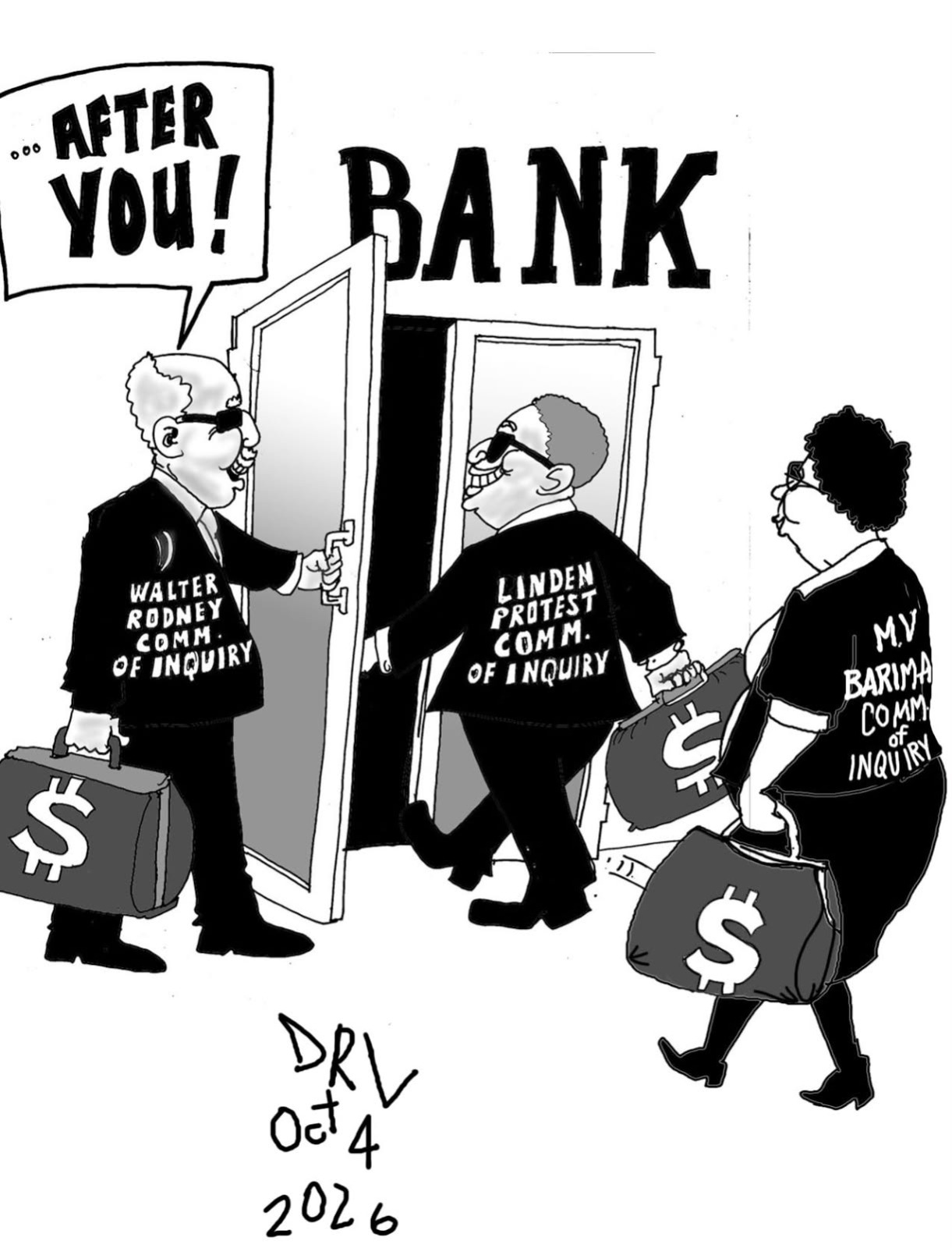
- MV Barima CoI to last 6 months amid boycotts, protest over unsalvaged vessel
- President’s Lawyer admits reporting Opposition Leader’s page before meta suspension
- Rodrigues-Birkett stands by Gaza ‘genocide’ remarks
The PPP never claimed purity

DEAR EDITOR,
It is always more fun than a challenge to respond to published letters penned by Eusi Kwayana.
Some have questioned the timing and the purpose of Kwayana’s letter published in SN of 26 March 2019.
I have known Eusi personally during political struggles associated with the Movement Against Oppression (MAO) Dr. Walter Rodney, the three trials Arnold Rampersaud, the Mahaicony Three, the struggles of the bauxite workers in alliance with sugar workers, the Committee in Defence of Democracy (CDD) and the Patriotic Coalition for Democracy (PCD)
I concede that those are obviously not enough to really know Eusi Kwayana.
As far as his membership and association with the PPP is concerned, there is enough in the party’s and Red House’s archives that speak to what manner of man Sydney King now Eusi Kwayana was in the ‘Old PPP.’
I consider it necessary to establish these facts before proceeding to respond to his letter.
Kwayana’s political activism would, probably, stretch way back to the 1940’s. April 4, will mark his 94th birthday.
It is not unusual for Kwayana’s writings to be situated in a historical context, particularly as regards the ‘Old PPP’ which he had a strong relationship with in its early beginnings.
Since the PPP is made up of neither eunuchs nor saints it would be obtuse for anyone to claim that the PPP is a model of purity, electorally or otherwise.
In fact, any political party that sets itself atop a pedestal, pretending to be a paragon of virtue should be called out and made to answer for its pretentiousness and demagoguery.
Long before the transformation of the PPP from a loose mass party to a more disciplined type of party, the PPP has, at numerous party congresses, regional and district conferences and at party group meetings, conceded its deficiencies at the organizational and ideological levels. Corrections and adjustments have been made along the way.
The Constitution of the ‘modern PPP’ states inter-alia:
‘The Central Committee shall take the initiative for the development of fullest criticism and self-criticism. All criticism must take place in the appropriate party bodies and meetings.’
Mr Kwayana is historically correct in his characterization of the 1953 electoral era and the legal age for voting at that time. However, as regards Dr. Jagan’s urgings to crowds at that time, as per registration telling them “if you can marry at 18 and fight at 18, you can vote at 18,” I prefer to contextualize and make more precise what Kwayana chose to put in more popular language.
Ever since the PPP was formed in 1950, it has been advocating the vote for 18 years and over.
The party’s first demand for the vote at 18 was in late 1950, when a team of party representatives appeared before a Commission to prepare for the introduction of the Ministerial system of government.
Mr Forbes Burnham, the then Chairman of the PPP was a member of the delegation. He supported the argument before the Commission for the vote at 18.
The 21 versus 18 voting age became a flash point during talks for an independent Guyana.
During those talks, Jagan called for a ‘A fully self-governing territory’ while Burnham countered with his call for ‘Full internal self-government.’
Under pressure from his constituents and recognizing Jagan had a much more advanced nationalistic position reflected in his call for independence, Burnham changed his position and called for independence under the proportional representation system.
Burnham came under criticism from Sydney King now Eusi Kwayana, his party’s General Secretary, when he declared that: “… the Burnham statement is dangerous to the African people. I cannot be part of Burnham’s plan. His plan is to help Jagan win independence. A seat is reserved for him on Jagan’s plane.”
King was subsequently expelled from the party.
Later, by a strange twist of events, Burnham and King joined up under the common slogan ‘No Independence Under Jagan.’
Both men were now tethered to an anti-PPP bandwagon in support of voting at 21. A position favoured by the colonial authorities.
The rationale behind the party’s demand for voting at 18 was based on the law that existed at the time in the colony.
Accordingly, a person was entitled at the age of 18 to be employed in the public service of the colony. That person could become a member of the police or military forces. Moreover, a male person at that age could have assumed responsibility for a wife and raise a family.
Thus it was felt that if a person is capable of assuming all these responsibilities, then surely he/she would be mature enough to exercise the vote with reason and good sense.
So, while I would not break a lance over Kwayana’s popular formulation as to how the PPP’s call to register was put to crowds, it was certainly not only a case of being able to marry and fight at 18, it was much more than that.
The point to note here, though, is that Burnham somersaulted from vote at 18 to vote at 21, because it was clear to him that the PPP would win elections outright, both he and Kwayana wanted to block that from happening.
As regards the imbroglio at the Houston constituency in the 1961 elections, this matter has been weaponized by others, just as Eusi did in this letter claiming that ‘The PPP was not a model of electoral purity.’
In his ‘West on Trial’ Cheddi Jagan wrote; ‘We had no direct responsibility for the conduct of the 1961 elections; it was conducted under the authority of a British official holding the office of Chief Secretary and under the direct supervision of an Electoral Officer who was an Englishman.
As regards the registration of voters, the Chief Electoral Officer took every care to ensure, scrupulously, fairness in registration. It was the PPP which called in the police when it became known that attempts were being made to pad the list for the Houston Constituency, for which a by-election was pending.
A statement made by the Attorney General on March 27, 1963, in connection with the registration of voters pointed out:
‘The investigations which are being made by the police into the supplementary Voters’ List for the Houston Constituency are not complete, but an interim report concerning 686 names already investigated discloses the following: ‘’The number of voters seen out of a total of 686 so far investigated amounts to 294. Of the latter number, 15 persons are under the voting age. Of the remaining names, 79 were never heard of at all and 204 are alleged to have left the constituency.”
The police also stated that of the 686 claims investigated out of a total of 1,507 registered names, 109 (including 2 believed dead) could not be found at all.
Dr. Jagan concluded; ‘We did not object to changes in the arrangements for the registration of voters and the conduct of the election, but we deplored the attempt of the British government to impute misconduct by insinuations and falsehoods in order to discredit us.’
In the midst of independence talks and country-wide disturbances resulting from violence unleashed on the basis of the PNC’s X-13 plan during the 1962 to 1964 period, some who have weaponized the Houston debacle, refuse to recognize that it was the British and not the PPP’s responsibility to offer an explanation to the public about the events at Houston.
But the more important question was: who were the culprits who had inserted the 109 electoral impurities on the Houston constituency voters list?
British elections officials were in charge of elections at the time, but they never wanted to pronounce on the matter, since the objective was to have a weak and not a stable government, though the PPP, beyond all expectations, had won 20 out of the 36 seats. Through the annals of history, the practice of rigged elections has plagued Guyana. And 7 out of every 10 every Guyanese at home and abroad know who the practitioners of electoral fraud in Guyana are. The culprit’s rap sheet is in the public domain.
Those who claim that the PPP was/is ‘not a model of electoral purity’ must provide incontrovertible evidence, whether from the British archives or from the reports of any of the international observer missions who observed elections in this country during the days of the old or modern PPP, to justify their case.
Yours faithfully
Clement J. Rohee
Share this:

Discover more from Kaieteur News
Subscribe to get the latest posts sent to your email.
Similar Articles
Website Hits

Blunt of the day

Sports
Features/Columnists

Sir. Ronald Sanders

The GHK Lall Column

Weekend Cartoon