Latest update September 21st, 2026 2:51 PM


Latest News
- Three killed in Baramita clash
- Defense accuses Police of misrepresenting court testimony, Magistrate says court unfazed by media
- Mohamed alleges political hand behind review of Justice Persaud’s U.S. visa
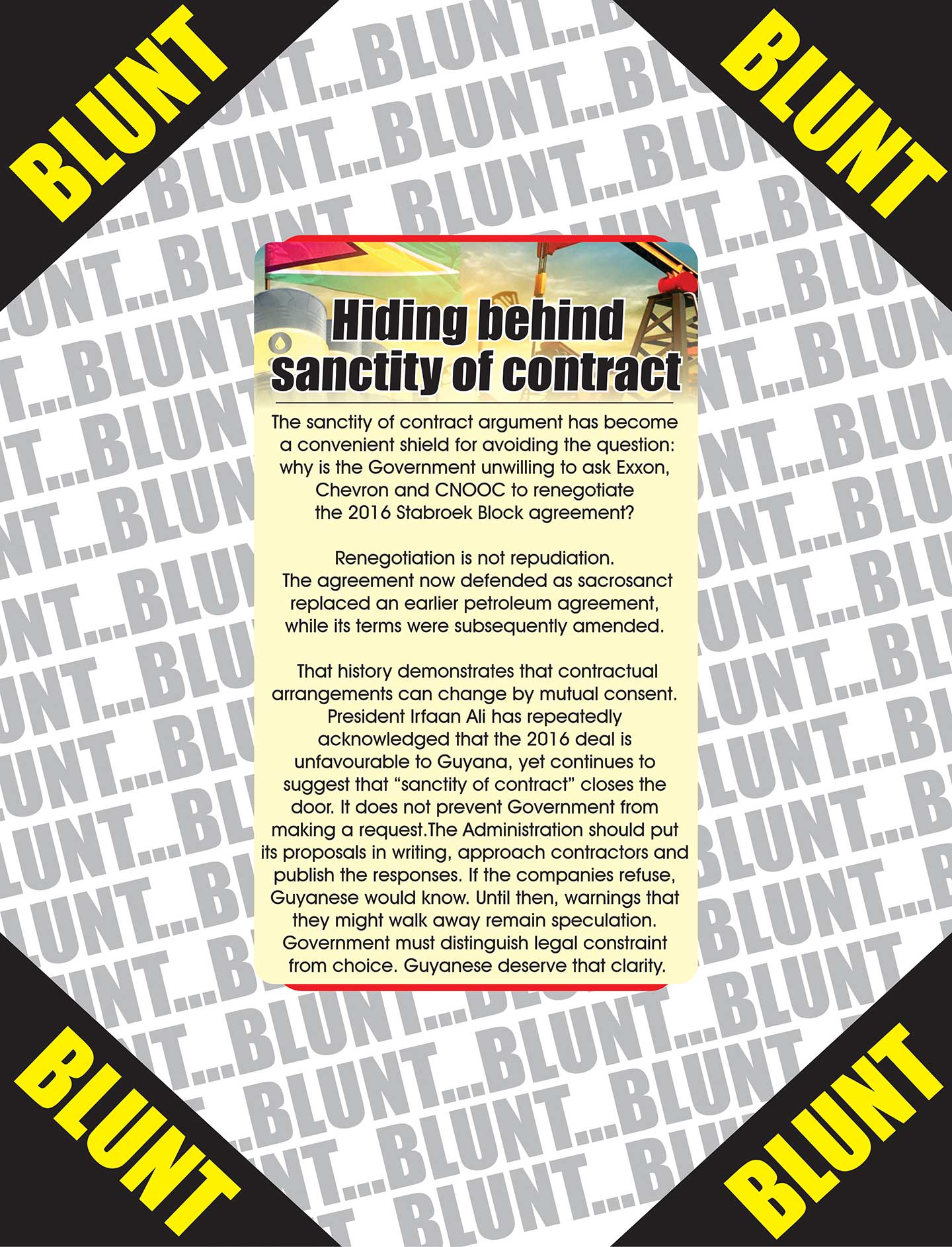
- ‘Stop blaming ‘sanctity of contract’ for keeping 2016 oil deal – Chris Ram tells Pres. Ali
- Iran and U.S. trade threats after Houthi attacks escalate regional conflict
WARNING SIGNALS!
The secret about understanding the reports made by the International Monetary Fund is to learn to read between the lines. The IMF does not wish to ring alarm bells in the country by its report of its Article IV Consultation on Guyana. But it sent out smoke signals about areas where greater attention needs to be paid.
The media has, so far, presented a lopsided report on the IMF findings which makes it seem as if Guyana’s economy is not in a bad shape.
A careful reading of the report however identifies a number of risks facing the Guyanese economy.
The first is the uneven growth in the economy. Guyana’s economy is effectively on one cylinder. It is akin to an airplane which is gaining altitude but based on the one engine alone. If that one engine begins to malfunction, that is, if gold prices dip or fuel prices increase then the economy will enter a free fall mode from which there can be no return. Too much is therefore hinging on one commodity. It is dangerous for Guyana.
Secondly, even though inflation was low at 1.5 % in 2016, it is projected to increase by a full 1%. There is a view in Guyana that inflation is likely to be far higher.
Thirdly, the government is keeping reserves at around 3-5 months of imports. This is too cautious a position by the government. It mimics the PPPC’s monetary policy. There is no need for reserves to be more than three months of imports, not when there is a forex shortage.
The IMF is hoping that Guyana’s international reserves will be boosted when oil production starts in 2020. But what if it does not start then? What happens then? There is no plan by the government to increase export earnings, and this in a country whose economy is supposed to be export oriented.
Fourth, the fiscal deficit will get worse but not dangerously so. It is only expected, according to the IMF, to reach about 7% of GDP. This is nothing to be alarmed about. But what is of greater consequence are the measures that the government is likely to take to reduce this deficit. A cut in expenditure which is being suggested by the IMF, will hinder the priming of the economy for economic take-off in 2020 when oil revenues are supposed to roll in.
Fifth, the IMF is recommending its usual medicine of fiscal consolidation. What this means in common language is that the government should be spending less and increase its tax take, as opposed to increasing taxes. Unfortunately, it is consumers who will feel the pinch.
Sixth, the IMF is urging an improvement in the business climate. The government has not had a good relationship with established private sector bodies. This, it is felt, has to do with the fact that these bodies were seen as being close to the opposition PPPC when that party was in power. It is a blinkered position by the government, because the private sector has traditionally been close to all governments; PNC and PPPC. The reason why it is not close to this government is because time has not been taken by the present government, to establish good relations with the private sector. It is a sign of political arrogance.
Seventh, the IMF mission urged that the reforms in the sugar sector continue but suggested that a social impact of the overhaul be done. This is most likely a compromise which the IMF came up with in order to balance the position of the government with that if the opposition, in relation to the sugar industry. The government wants to close estates. The opposition is calling for a social impact assessment before any estate is closed.
Eight, the IMF sees the possibility of VAT reforms impacting in inflation. It does not say so directly, but it can be deduced that this impact can be negative. The IMF is calling for closer monitoring of VAT on inflation.
Ninth, the IMF has recommended that that any official foreign exchange purchases and sales use a market mechanism similar to the one used for auctioning treasury bills. This is another way of saying let the market determine the price of foreign exchange. But we know that the only road this will take us is the devaluation road.
Tenth, the IMF is sending smoke signals about the increase in bad loans – which it called non-performing loans.
Share this:

Discover more from Kaieteur News
Subscribe to get the latest posts sent to your email.
Similar Articles
Website Hits

Blunt of the day
Sports

Features/Columnists

Sir. Ronald Sanders

The GHK Lall Column

Weekend Cartoon