Latest update February 25th, 2026 12:59 AM

Feb 25, 2026 Features / Columnists, Peeping Tom
Kaieteur News – Every society must decide what is worthy of moral outrage. That, in essence, is a question about justice. And questions of justice are rarely about the surface facts alone; they are about the principles we think are at stake.
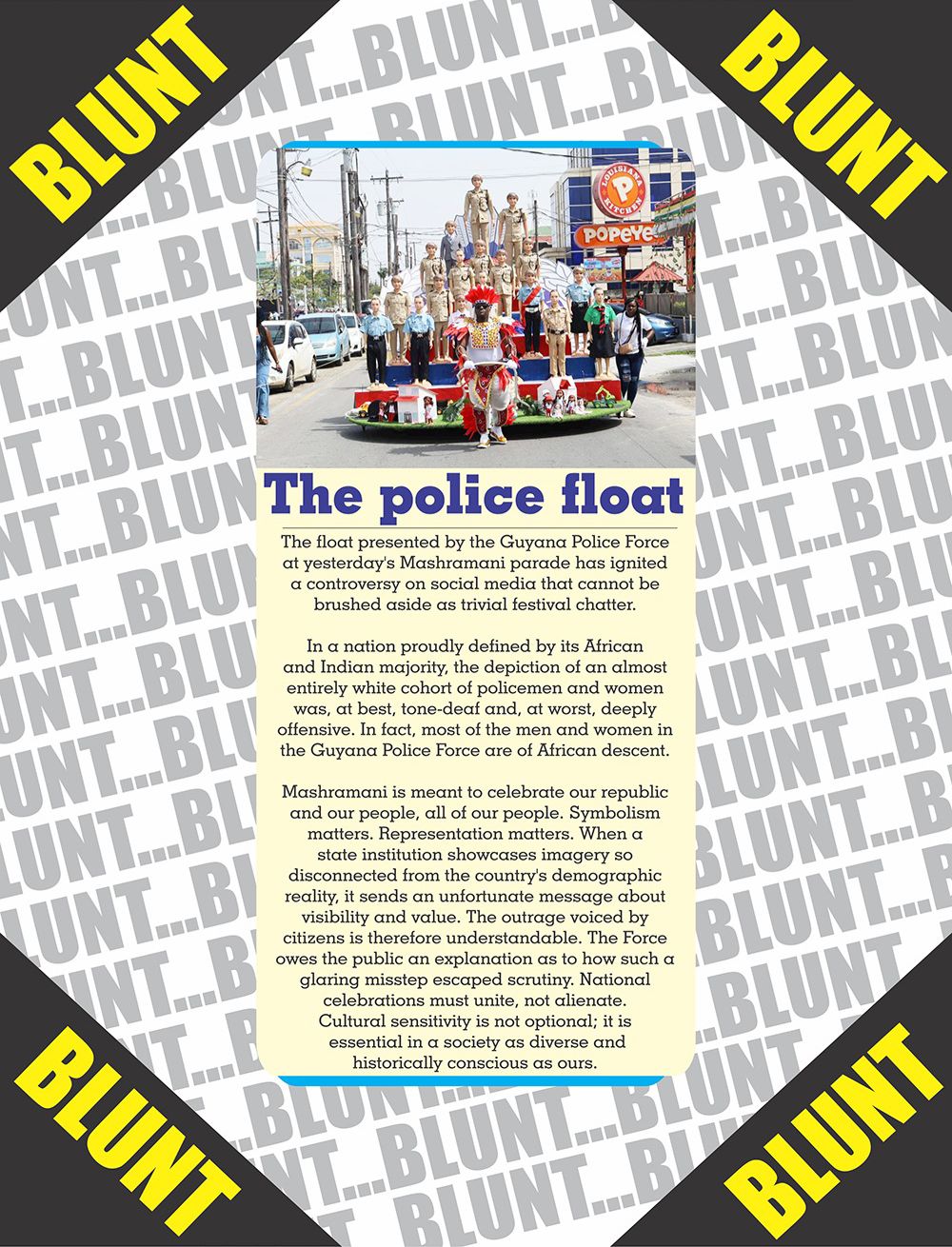
The recent controversy over the Guyana Police Force’s Mashramani float invites such reflection. The float displayed mannequins dressed in the various uniforms of the Force, from constables to senior officers. The stated purpose was clear: to exhibit the ranks and regalia of the institution. Yet criticism emerged because the mannequins were all light-complexioned, and therefore, it was argued, not representative of the ethnic composition of Guyana or even of the Police Force itself.
But what exactly is the moral claim here?
If the display had been intended to portray the ethnic diversity of the nation, the criticism might carry weight. Representation would then be the central purpose, and a failure of representation would undermine the exhibit’s integrity. But the float was not about demography. It was about uniforms — about the visible symbols of rank and service. The mannequins were props, not portraits.
It is always necessary when examining a controversy to clarify the purpose of an action before judging it. What is the telos— the end or goal—of the practice under scrutiny? In this case, the telos of the float was to showcase the attire of the Force. The complexion of the mannequins was incidental, not essential.
To insist otherwise is to shift the purpose of the display after the fact.
Consider the mannequins in boutiques and department stores across Guyana. They are often of similar light complexion. They display clothing, not ethnicity. Few protest their presence as a distortion of national identity. Why? Because we understand that the purpose of a mannequin is functional. It holds garments. It demonstrates fit and form. It is a commercial instrument, not a sociological statement.
Why, then, should the Mashramani float be judged by a different standard?
One might argue that public institutions carry a heavier symbolic burden than private businesses. That is a fair point. Public bodies must be attentive to inclusion. But attentiveness to inclusion does not require us to interpret every aesthetic choice as a moral declaration. If we do so, we risk trivializing genuine questions of representation by attaching them to matters where no substantive exclusion has occurred.
There is a deeper issue here about the kind of civic culture we are cultivating. Are we a people inclined to assume bad faith? Or are we capable of distinguishing between symbolic harm and incidental detail?
When every action is interpreted through the most suspicious lens, public discourse becomes brittle. We begin to see slights where none were intended. We elevate minor imperfections into moral failings. And in doing so, we exhaust the moral vocabulary that ought to be reserved for real injustice.
Guyana is a plural society. Its history makes questions of race and representation sensitive and important. That is precisely why discernment is required. Not every light-complexioned mannequin is an affront to national diversity. Not every oversight is an ideological statement. To claim so is to blur the distinction between deliberate exclusion and ordinary circumstance. We must ask: does the alleged wrong rise to the level of public condemnation? What harm has been done? Who has been excluded? In this case, no citizen was barred from participation. No rank was denied recognition. The float did not declare that the Police Force is ethnically uniform. It displayed uniforms — period.
Mashramani, after all, is a celebration of republic, unity, and shared national pride. It is meant to affirm what binds us together, not to amplify what divides us. To turn a display of police regalia into an ethnic controversy may reveal less about the float and more about our civic temperament.
The real question, then, is not about mannequins. It is about moral judgment. Are we capable of calibrating our responses to match the gravity of the issue? Can we preserve our moral energy for substantive injustices — economic inequality, public safety, educational opportunity — rather than dispersing it over mannequins on a Mashramani float?
A mature democracy requires citizens who can tell the difference between symbolism and substance. If we lose that ability, we do not strengthen our commitment to justice; we weaken it. The float was about uniforms. The controversy is about us.
(The views expressed in this article are those of the author and do not necessarily reflect the opinions of this newspaper.)
Your children are starving, and you giving away their food to an already fat pussycat.
Feb 25, 2026
Kaieteur News- FM Rawle Allicock delivered a flawless performance last Saturday, February 21st, 2026, in the Mashramani Open Blitz Chess Competition sponsored by the Guyana Chess Federation (GCF) and...Feb 25, 2026
Kaieteur News – Every society must decide what is worthy of moral outrage. That, in essence, is a question about justice. And questions of justice are rarely about the surface facts alone; they are about the principles we think are at stake. The recent controversy over the Guyana Police...Feb 22, 2026
By Sir Ronald Sanders (Kaieteur News) – If U.S. Secretary of State Marco Rubio accepts the invitation to attend the CARICOM Heads of Government meeting in St Kitts and Nevis from 25 to 27 February, his presence should be treated as consequential. It would offer an opportunity to recalibrate the...Feb 25, 2026
Kaieteur News – It is now over five years since Irfaan Ali holds national leadership. Excellency Pres. Dr. Mohamed Irfaan Ali, to dispel any hairbrained ideas about disrespect. I thought that over half a decade later, he would be better. A thought that now mocks. I calculated that he would...Freedom of speech is our core value at Kaieteur News. If the letter/e-mail you sent was not published, and you believe that its contents were not libellous, let us know, please contact us by phone or email.
Feel free to send us your comments and/or criticisms.
Contact: 624-6456; 225-8452; 225-8458; 225-8463; 225-8465; 225-8473 or 225-8491.
Or by Email: glennlall2000@gmail.com / kaieteurnews@yahoo.com