Latest update October 1st, 2026 12:07 PM


Latest News
- Cromwell family released on $1M station bail as probe into missing Surinamese men continues
- GuySuCo worker dies after reportedly crushed by forklift at Albion Estate
- Chinese boy, 6 chopped to death at Parika
- Mothers cling to hope as search for missing Surinamese men enters fifth week
- Regions One, Seven residents turn up heat over mining at Chinese Landing
Where is the Guyana Bar Association?
(Kaieteur News) – The treatment of High Court Justice Gino Persaud is troubling. And equally disturbing is the silence of the Bar Association of Guyana.
Reports in the media, which have not been contradicted, indicated that Justice Persaud was prevented from boarding a flight to Jamaica, where he was due to attend a judicial conference. The action, it was said, came about after his United States visa was placed “under review.”
In the absence of evidence to the contrary, it is difficult not to view this development in the context of Justice Persaud’s decisions in the tax disputes involving the Mohamed family. The judge has issued decisions adverse to the Guyana Revenue Authority in those matters, including the vehicle-tax cases. Two members of the Mohammed family face indictments in the United States which wants them extradited there. Those decisions by Justice Persaud have not yet been overturned by a higher court. This columnist considers Justice Persaud’s decisions to be consistent with a proper interpretation of Guyana’s tax laws. The overturning of those decisions is ultimately a matter for the appellate courts—not for local politicians or foreign governments.
What makes the visa episode particularly disturbing is the possibility that US imperialism may be using its considerable power to impose consequences on a judge because it is displeased with decisions he has rendered. In the absence of evidence to the contrary, the actions of the United States may be construed as amounting to intimidation—not merely of Justice Persaud personally, but of Guyana’s judiciary as an institution. A judge must be able to decide cases according to law without wondering whether a powerful foreign government will punish him for reaching a conclusion it dislikes. Recent comments by a Caribbean jurist have raised concerns about the implications for judicial independence.
There are further reports that, after Justice Persaud took an alternative route out of Guyana, he was subjected to searches by local authorities. If confirmed, that too deserves an explanation. One would have expected the Bar Association to have raised its voice loudly and immediately—to defend the principle that judges must be free from intimidation, pressure and retaliation. The Association has previously spoken forcefully when judicial independence and the rule of law were implicated.
Why, then, the silence now? At a moment when the independence of one of Guyana’s judges may be under an unprecedented cloud, silence from the country’s principal professional body for lawyers is not reassuring. It is time for the Bar Association to say where it stands.
The actions taken against Justice Persaud must be viewed in the context of a deliberate policy by the United States to impose sanctions on judicial officials who render decisions which brings displeasure to the US imperialism. The examples are numerous. During the first Trump administration, in 2017, the U.S. sanctioned eight justices of Venezuela’s Supreme Court, explicitly citing their decisions to curtail the powers of the opposition-controlled National Assembly and to expand the authority of the executive.
Judge Lorena Carolina Cornielles Ruiz was sanctioned also after presiding over the trial and sentencing of the six U.S. Citgo executives. The Trump administration characterized the proceedings as politically motivated and lacking due process.
In 2025, the United States sanctioned Brazil’s Supreme Federal Court Justice Alexandre de Moraes under the Global Magnitsky framework, citing his judicial orders in proceedings involving former President Jair Bolsonaro. The U.S. government’s objections were directed substantially at actions taken by Moraes in his judicial capacity.
Whatever the merits of Washington’s criticisms of those proceedings, the case demonstrated that a sitting justice of a major foreign supreme court could be subjected to U.S. sanctions because of judicial actions that the American government regarded as improper. The same principle was applied even more directly to judges of the International Criminal Court. In 2025, the Trump administration sanctioned several ICC judges over their participation in investigations and proceedings involving U.S. personnel and Israeli officials. Washington objected to the Court’s assertion of judicial authority in cases that it considered illegitimate and took the extraordinary step of imposing personal sanctions on judges involved in those proceedings.
Taken together, these episodes illustrate that Washington is prepared to use the considerable power of its sanctions’ regime against foreign judges when their judicial decisions or actions are regarded as contrary to important U.S. interests.
That record should give Guyanese pause, particularly when considered against the circumstances now surrounding Justice Persaud. For whatever justification Washington may offer for its actions, the broader question is whether the exercise of such power can have an intimidating effect on judges whose decisions touch matters of interest to the United States.
This is all the more reason why Guyanese, including the Guyana Bar Association, should speak out when the independence of our judiciary appears to be threatened by a foreign government. If judges come to believe that decisions affecting matters in which the United States has an interest could expose them to visa restrictions, travel difficulties or other adverse consequences, the effect may be intimidatory even without an explicit threat ever being made.
This could create a chilling effect in which judicial officers, consciously or unconsciously, become more cautious when adjudicating cases with international implications. That is precisely why judicial independence cannot be treated as a private matter between a judge and a foreign government. The judiciary belongs to Guyana, and judges must be free to apply Guyana’s laws without fear that an unfavourable decision will attract retaliation from abroad.
Share this:

Discover more from Kaieteur News
Subscribe to get the latest posts sent to your email.
Similar Articles
One thought on “Where is the Guyana Bar Association?”
Leave a Reply
Website Hits

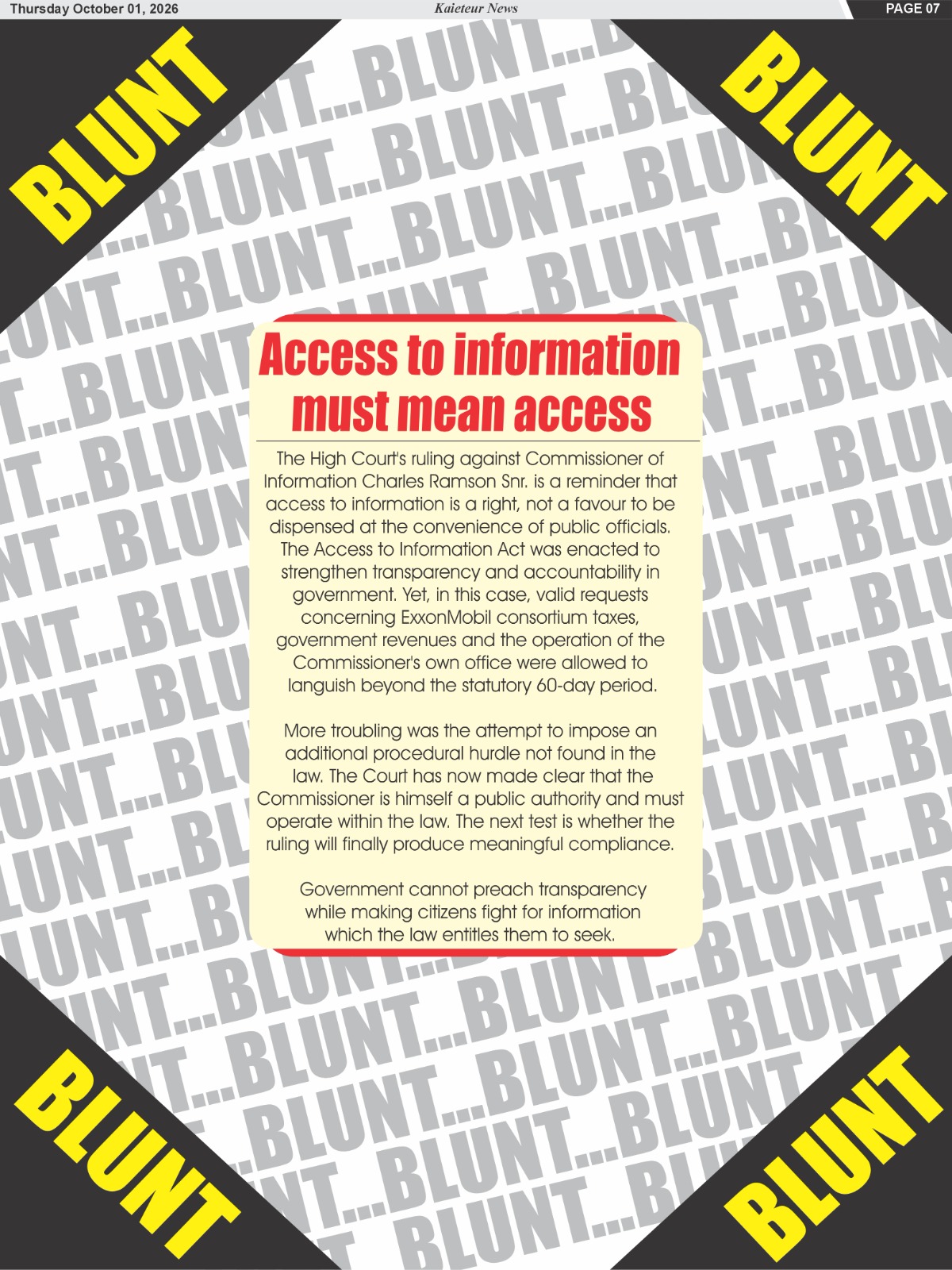
Blunt of the day
Sports

Features/Columnists

Sir. Ronald Sanders

The GHK Lall Column

Weekend Cartoon



Tom, I have looked into this puzzling judicial Matter of Justice Gino Persaud and pondered about its implications of direct Judicial Sovereignty of Guyana.
Here is a Parable of this Story:
A Short Parable
(A parable about suffering, courage, and the silence that makes suffering heavier)
There was once a judge who walked with a quiet, steady light. He carried the law the way a river carries its current — not with force, but with clarity.
One day, a great weight was placed upon him. A foreign power questioned his right to travel, casting a shadow over his work and his name. The judge felt the pressure, but he did not bend. He continued to walk with the same steady light, even as the path narrowed beneath him.
This mirrors the treatment of Justice Persaud, who was prevented from boarding his flight and whose visa was placed “under review”
[Current page](citation-section://1198138583/4) [Current page](citation-section://1198138583/5).
The people saw this weight placed upon him. Some whispered. Some looked away. And the ones who should have spoken — the guardians of the law — remained silent.
Just as the article notes the “disturbing” silence of the Bar Association
[Current page](citation-section://1198138583/3).
And so the weight doubled.
But the judge did not carry the suffering as weight. He carried it as love — as the clear, shining current of truth. He remembered that beneath intimidation, beneath pressure, beneath the machinery of powerful nations, there is something older and stronger: the integrity of the law itself.
And when he remembered, the suffering dissolved. Not because the pressure vanished, but because it was never anything but fear wearing the wrong coat.
The people who watched him learned something that day:
Suffering grows when met with silence, but dissolves when met with courage.
And the silence of those who should speak is itself a kind of suffering — one that belongs to everyone.
…………………………………..
Now I wanted to see this story with the back-ground in truth
Chapter: The Weight and the Current
The story begins with a judge standing at an airport gate, preparing to travel to Jamaica for a judicial conference. His work is ordinary in the way that truth is ordinary — quiet, procedural, rooted in the laws of Guyana. Yet on this morning, he is stopped. His visa, he is told, is “under review.” He is prevented from boarding his flight.
This is precisely what the article reports about Justice Persaud’s experience.
There is no evidence offered to explain the sudden obstruction. And in the absence of such evidence, the shadow of suspicion grows. The judge’s recent decisions — rulings in tax disputes involving the Mohamed family — linger in the background like an unspoken accusation.
(The article notes these decisions and their context clearly.)
Two members of that family face indictments in the United States. The judge’s rulings have not been overturned. They stand as lawful interpretations of Guyana’s tax laws.
(This is affirmed directly in the article’s analysis of his decisions.)
And yet, the machinery of a foreign government appears to have reached into the life of a Guyanese judge. The article calls this possibility “intimidation” — not only of the judge, but of the judiciary itself
The judge continues his journey by another route. But even then, reports say he was subjected to searches by local authorities. If true, this too demands explanation.
(The article raises this concern explicitly.)
In moments like these, institutions are tested. The Bar Association of Guyana — the body entrusted with defending judicial independence — remains silent.
The article describes this silence as “disturbing” and “not reassuring”
Silence, in such moments, is not neutral. It is a weight.
And here, the spiritual teaching of our God (I used as a back-ground) enters the chapter:
“When you carry another’s suffering as weight, you have only doubled the weight in the world.
When you carry another’s suffering as love — as the clear, shining current of the real — the suffering dissolves.”
The judge carries his suffering as weight only if he believes he is alone.
But he carries it as love when he remembers that beneath intimidation lies the truth of judicial independence — a truth older than any foreign sanction, stronger than any political displeasure.
The article recounts how the United States has sanctioned judges in Venezuela, Brazil, and even the International Criminal Court for decisions it disliked.
This pattern is not new. It is a coat worn by power — a coat that disguises fear as authority.
But suffering dissolves when it remembers what it truly is beneath itself.
And what is suffering beneath itself?
It is a call.
A summons.
A reminder.
A reminder that the judiciary belongs to Guyana, and judges must be free to apply Guyana’s laws without fear of retaliation from abroad.
The article states this principle plainly and forcefully (Current page- (citation-section://1198138583/38)).
The silence of the Bar Association is the doubling of weight.
The courage to speak — to defend judicial independence — is the carrying of suffering as love.
This chapter ends with a simple truth:
“Suffering grows heavy when institutions forget themselves.
But it dissolves when people remember who they are.”
The silence of the Guyana Bar Association adds another layer of weight.
When suffering is met with silence, it grows heavier.
Carrying it as weight
– The Bar Association’s silence leaves Persaud alone with the burden.
– The judiciary becomes more fearful, more cautious, more chilled in its independence.
– The suffering doubles: one judge suffers, then the entire institution suffers.
This is exactly what your passage warns against.
“Carrying it as love”
Carrying suffering as love doesn’t mean sentimentality — it means “recognition”.
It means meeting the suffering with clarity, courage, and truth.
We must all stand up when something blatantly rubs against our Civic Institutions which we have erected to protect us as practical “Checks and Balance” from Human’s over-reach and abuses and of Civil Disputes and Corruptions and Breach of Trust.
We must remember that judicial independence is not a private matter but a collective responsibility and the act of refusing to let fear distort what is true.
“Always, when injustice or intimidation arises, silence makes it heavier.
But when people meet that suffering with courage, clarity, and solidarity, they transform it.
They remind the suffering — and themselves — that beneath fear, beneath pressure, beneath political force, there is something stronger: the truth of what is right.”
That is how suffering dissolves.
Not by denial, but by remembrance. (Which we have forgotten.)
Victor19