Latest update July 23rd, 2026 12:30 AM



Latest News
- MV Barima Disaster… Brazil, T&T come to Guyana’s rescue
- Govt. cannot investigate itself! – Amanza Walton
- Billions from oil, no safe passage for hinterland residents – MP Hastings on MV Barima tragedy
- Oil settles up more than 3% to six-week high as Mideast conflict threatens oil transit routes
- Opposition unites in call for Edghill to go
‘Guyana’s security apparatus weak’ …Paul Slowe warns AK-47 seizures, bombings point to national security emergency
(Kaieteur News) – Former Assistant Police Commissioner Paul Slowe has sounded the alarm over Guyana’s deteriorating national security system, warning that the recent seizure of 33 illegal assault rifles, coupled with a series of bombings and acts of sabotage, signals a full-blown national security emergency that has outgrown the scope of ordinary policing.
Speaking on the heels of successive law enforcement operations that netted a total of 33 illegal assault rifles, Slowe asserted in an exclusive interview with Kaieteur News that the country’s security architecture is lagging dangerously behind its rapid economic transformation. He called for immediate international intervention to dismantle what he believes is a highly organised, sophisticated criminal network.
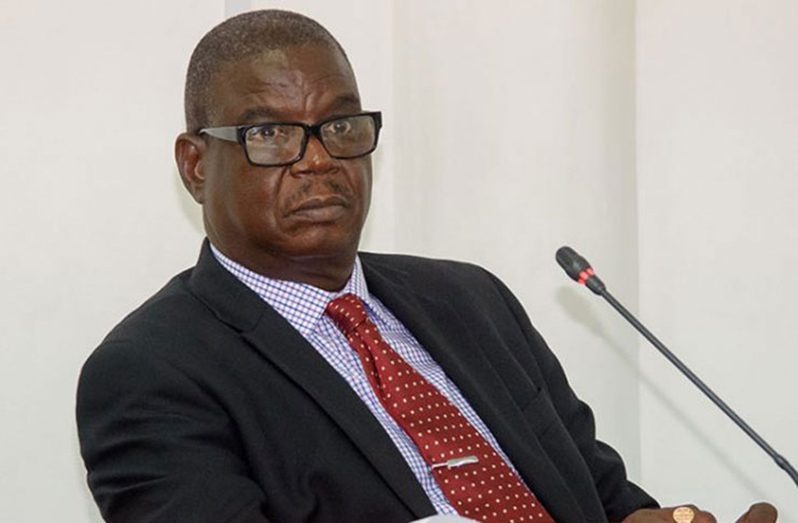
Former Assistant Commissioner, Paul Slowe
The recovery of 33 assault rifles has sent shockwaves through local law enforcement. According to police reports, 32 of the 33 seized weapons had their serial numbers meticulously obliterated to conceal their origins. Slowe dismissed the notion that the cache was intended for low-level street crimes, pointing instead to a much larger security threat.
“Well, definitely the fact that 33 assault rifles can be discovered in such a relatively short space of time is cause for serious concern. So, because you don’t know if this is just the tip of the iceberg, you don’t know the extent of the problem, so it is definitely a need for concern. We also don’t know the motive; we don’t know the reason why these weapons are in the country. Is it that they’re just in transit, passing through to go someplace else, or is it that they are intended to remain in Guyana?” Slowe stated.
The former assistant commissioner emphasised that the sheer volume of military-grade firepower elevates the situation from a routine law enforcement matter to an immediate national security emergency. He noted that the nature of these firearms points directly toward a coordinated enterprise rather than petty criminals.
“This is no longer a strictly police or law enforcement issue. This has to be dealt with as a national security matter,” Slowe asserted adding “… this is not, in my view, this type and quantity of firearms cannot be intended for any small-time criminal activities. This is, we’re talking about arming at least, based on what was discovered, 33 people. So, there ought to be some, maybe, some well-organised gang… It can’t be any small-time criminal. It’s got to be some big network, again, because of the number and type of firearms. It’s got to be something along with some network.”
Border security
Meanwhile, Slowe said the shipments of the guns have exposed critical vulnerabilities in the country’s border security, ports of entry, and intelligence frameworks. While state agencies have suggested that the weapons were smuggled through official maritime wharves in Georgetown, Slowe pointed out glaring contradictions and apparent failures within the current state narrative.
“Well, the fact that the numbers of, were attempts, I would say, attempts were made to conceal the number, the serial numbers of these firearms, then shows that whoever are bringing them in, there’s some level of organisation and that we are trying to ensure that the origins of these firearms are not known,” Slowe explained.
Further, the former assistant commissioner said, “It would appear as though the security forces are somewhat reactive in that they will tell us that these things are some intelligence-led operation… But if you have a proper intelligence system, then maybe they should be prevented because they too are suggesting that these things came through the wharves. Well, if they came through the wharves, why were they not detected at that point and prevented from entering into the country?”
Slowe suggested that the “failure is at the border; at the wharves.” He said that it is difficult to believe that the guns are coming through the wharves undetected.
When questioned on whether Guyana’s security agencies have simply failed to keep pace with the rapid transformation brought on by a booming oil economy and increased migration, Slowe agreed. He noted that traffickers appear confident that they can exploit these weaknesses, and raised the alarming possibility of past undetected shipments or internal collusion.
“Definitely, the security forces have not been equipped to the point where we can have any confidence that these battles such as these are intercepted or prevented from coming in. The fact that people can ship that number of firearms, again, indicate that maybe the people who are trafficking these firearms are confident that because of the poor estimation of these many borders, we can get away with this. Again, the question is, how many similar shipments have been made that have not been detected? There’s a question that will always be in the forefront or should be in the forefront of the security forces,” Slowe said.
Rather than laying blame on a single agency, Slowe emphasised that accountability must be shared across all branches of state security and governance, urging a collaborative approach rather than political finger-pointing.
“All of the agencies, starting with the government, the police, CANU, the GRA, all the agencies. This is not to lay blame and say who’s involved and who’s not involved. This is a serious, serious national security issue. All the agencies involved in national security, including the government, the central, the other intelligence agency, all of them have to bear some responsibility and I hope they will come together and address this thing in a very comprehensive way and don’t attempt to just point fingers,” Slowe noted.
He added that investigators cannot afford to be complacent or assume that luck allowed them to catch every weapon that has entered the borders, stressing that the suspects currently in custody must be thoroughly interrogated to uncover the true scope of the pipeline.
“I’m not saying it’s the tip of the iceberg. You don’t know the extent of the problem. You don’t know if you have become so extremely lucky to intercept the only two shipments that were brought in. So, you can’t tell the extent of the issue until a proper, thorough investigation is done. And I’d say an investigation of this nature will require international assistance,” Slowe said noting that there must be an assumption that similar shipments were made.
“You can’t just put it down to being lucky and you’ll be able to intercept all of the firearms that were brought in. So, in terms of evidence, it is that easy for you to get evidence as to whether similar shipments were made or not. They have arrested persons, they put multiple people into persons. Let’s hope that the interrogation that will follow might unearth the evidence to suggest or to give you the extent of the issue,” he noted.
Slowe also refused to rule out the possibility that the smuggling operation was aided by individuals working within the state apparatus, arguing that a professional investigation must aggressively probe for internal corruption.
“Well, it could be collusion. And again, I say that is the reason why you have to have a proper investigation. I’m not saying there is, but you have got to investigate to rule out or to eliminate all those possibilities that there’s no collusion from state agencies or state individuals working on behalf of the state,” Slowe stated.
To unravel the network, Slowe insisted that Guyana must rely on forensic technology and external agencies like the FBI and Interpol to trace the weapons back to their source of manufacture in the United States.
“Because I know in matters like these, the police will reach out to Interpol, and they are likely to have an involvement in terms of assisting in tracing the firearms, in terms of assisting in identifying. Because again, the state told us that the serial numbers were obliterated. But their process is to recover those numbers, and that is the key to any investigation. Once the numbers are recovered, Interpol and those agencies can trace manufacturing and all that. Another agency that they should involve is the ATFA, the American Tobacco and Firearms Agency. They should have tremendous capacity,” Slowe said.
Reflecting on what changes, he would recommend to upgrade the national security architecture, Slowe pointed to structural reform, removing political interference, and managing security challenges related to the influx of foreign nationals.
“You have issues relating to foreign nationals, the influx of foreign nationals, Venezuelans in particular, because in this discovery, I think one Venezuelan is charged. So, these are some of the security issues that you’ll have to address immediately. You have to try to move politics out of it, and look at what is best for national security, and have those things implemented as soon as possible,” Slowe stated.
Slowe linked the recent firearms discoveries directly to a series of high-profile, unresolved acts of violence and sabotage across the country, arguing that successive administrations have failed to implement the deep personnel and structural changes required to protect the state.
“The security apparatus in the country is weak. There’s no doubt about that. And I think they have not been facing the real issue of making sure that you have the necessary changes in personnel and in the structure of the security apparatus to make sure that national security takes precedence over everything else. We have had so many incidents in recent times. You have the bombing of the Ruimveldt Police Station. You have the bombing of the GPL substation. You have the terrorist activity at the gas station in Regent Street. You have the discovery of the 10 assault rifles on the Corentyne… I mean, if you look at the picture, you realise that it is very, very worrying. And therefore, these things have to be addressed in a very comprehensive way,” Slowe warned.
Despite the growing sophistication of these illicit networks, Slowe concluded with a note of reassurance regarding the sheer firepower of state forces, though he raised a vital caveat regarding their operational readiness.
“The law enforcement agencies are well-armed. There’s no doubt about that. They’re well-armed. Whether they are adequately trained, that’s another issue. But I don’t believe that the criminal networks that you have can outgun the law enforcement agencies that we have,” Slowe stated.
Share this:

Discover more from Kaieteur News
Subscribe to get the latest posts sent to your email.
Similar Articles

Blunt of the day
Sports
Features/Columnists

Sir. Ronald Sanders

The GHK Lall Column

Weekend Cartoon