Latest update March 30th, 2026 12:35 AM

Mar 30, 2026 Features / Columnists, Peeping Tom
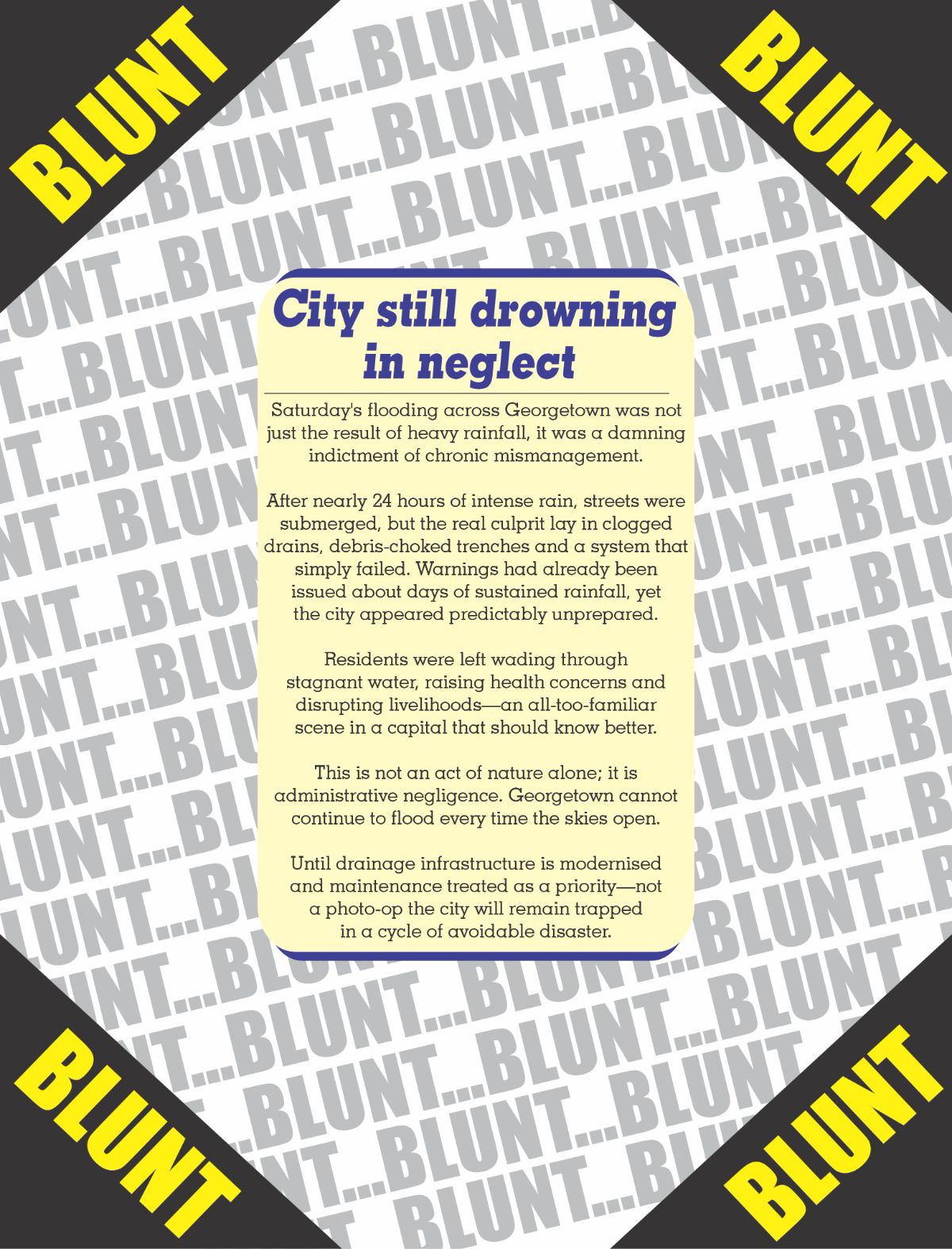
(Kaieteur News) – Days after Guyana positioned itself as a voice of authority on climate resilience, advising its Caribbean neighbours to “climate-proof” their infrastructure, the country found itself wading through a familiar and embarrassing reality, Floodwaters crept into homes, yards, and streets across some of the country’s most populated regions.
This was not a once-in-a-century storm. This was not an unforeseen disaster. This was rain that had been forecast days in advance. And yet, large sections of the coastland ended up under water. This raises a troubling question. After spending nearly G$200 billion on drainage and irrigation over the past six years, why does Guyana still flood so easily?
The explanation cannot simply be the volume of rainfall. We have seen heavier and more prolonged rainfall in the past without this level of flooding. The Meteorological Office did its job and issued warnings. That means the authorities had time to prepare. The issue, therefore, is not just nature; it is management.
Flood prevention begins long before the first drop of rain falls. It starts with ensuring that canals are properly cleared, that water levels are kept low in anticipation of incoming rainfall, and that drainage systems are fully operational. Were these steps taken? If they were, the results suggest they were insufficient. If they were not, then we are dealing with a failure of planning.
Georgetown, once again, bore the brunt of the flooding. This is not new. The city has well-known low-lying areas where water accumulates quickly during rainfall. These are not mysteries; they are mapped, studied, and understood. So, what proactive measures were taken to protect these vulnerable zones? From all appearances, very little.
Instead, there seems to be a heavy reliance on pumps as the primary solution. Pumps have their place, but they are neither the most efficient nor the most cost-effective method of drainage. Traditional systems, particularly kokers, have historically played a critical role in managing water flow. When maintained and operated properly, they allow gravity to do much of the work.
But that is precisely the issue. The problem is one of maintenance and operation.
Many of these kokers require desilting to function effectively. This is not an impossible task. With the use of pontoons and excavators, channels can be cleared and restored to proper working condition. The question is, how many of these structures were adequately maintained in recent years? The flooding suggests that the answer is not enough.
Even more concerning are reports that critical kokers were not opened at the appropriate times. One example is the koker at Cowan Street, which reportedly remained closed during low tide due to staffing issues. This is not a minor oversight. That koker serves a canal that stretches for miles, meaning that a single failure can have wide-reaching consequences for multiple communities.
There was a time in colonial Guyana when the operation of kokers was treated with urgency and precision. Systems were in place to ensure that gates were opened and closed at the right times. For example, a man was employed and his job was to cycle to every koker in Georgetown during rainfall. He did so on a bicycle ensuring that kokers doors were opened on time.
Do such systems still exist, or have they been allowed to deteriorate? The result of all these shortcomings is what we saw last Saturday—flooding that could, and should, have been mitigated.
Perhaps most troubling is the contrast between what is being said and what is being experienced. On one hand, there is talk of billions earned from carbon credits and investments in reducing flooding and supporting agriculture. On the other, there are citizens stepping through waterlogged streets, wondering how so much money has been spent with so little visible improvement.
This disconnect matters. It is one thing to speak about climate resilience on regional and international platforms. It is another to demonstrate it at home. Credibility is not built on statements; it is built on results.
If Guyana is to advise others on how to protect their infrastructure from natural disasters, it must first show that it can effectively protect its own. The flooding of last Saturday does more than expose weaknesses in drainage and irrigation systems. It calls into question the effectiveness of years of spending, planning, and policy. It suggests that somewhere along the line, priorities have been misplaced, systems have broken down.
Until those issues are addressed, the cycle will continue. Rain will fall, floodwaters will rise, and explanations and excuses will follow. But the public deserves more than explanations and excuses. It deserves solutions that work.
(The views expressed in this article are those of the author and do not necessarily reflect the opinions of this newspaper.)
Subscribe to get the latest posts sent to your email.
Your children are starving, and you giving away their food to an already fat pussycat.
Mar 30, 2026
Kaieteur Sports – Organiser of the Massy Distribution Secondary Schools Under-18 Football Championship, Petra Organisation, is hoping to resume proceeding during this week following the...Mar 30, 2026
(Kaieteur News) – Days after Guyana positioned itself as a voice of authority on climate resilience, advising its Caribbean neighbours to “climate-proof” their infrastructure, the country found itself wading through a familiar and embarrassing reality, Floodwaters crept into homes, yards,...Mar 29, 2026
By Sir Ronald Sanders (Kaieteur News) – The Organization of American States is approaching a defining test, not of its existence, but of its significance. It continues to meet, to commemorate events, but fails to tackle pressing political issues. At a time of global turmoil, economic strain, and...Mar 30, 2026
(Kaieteur News) – There’s much regard for Mr. Alistair Routledge, American oilman in Guyana. Exxon doesn’t put weaklings, dummies, misfits, or lamebrains in charge of a country operation. Not when big billions are involved. Not when fancy verbal footwork becomes an inseparable part of...Freedom of speech is our core value at Kaieteur News. If the letter/e-mail you sent was not published, and you believe that its contents were not libellous, let us know, please contact us by phone or email.
Feel free to send us your comments and/or criticisms.
Contact: 624-6456; 225-8452; 225-8458; 225-8463; 225-8465; 225-8473 or 225-8491.
Or by Email: glennlall2000@gmail.com / kaieteurnews@yahoo.com