Latest update November 21st, 2025 12:30 AM

Nov 21, 2025 News
Violence against women and girls continues to be a serious and persistent problem in the Region of the Americas, according to new estimates presented today by the World Health Organization (WHO) and UN partners. The data, released ahead of the International Day for the Elimination of Violence against Women and Girls on 25 November, reveal that one in three women aged 15 and older in the Region has experienced physical or sexual violence at some point in her life.
Intimate partner violence remains the most common form of abuse: one in four women aged 15-49 has experienced physical or sexual violence from a partner, while one in eight has suffered sexual violence from someone other than a partner. Young women face early risks, with 21% of those aged 15-19 experiencing partner violence before reaching 20, while older women are not spared: 23% of women aged 65 and above report such violence.
“These figures of women affected in our Region are so striking because violence is preventable. Collecting high-quality data on violence against women is the first step toward giving this important issue the visibility and urgency it requires,” said Dr. Jarbas Barbosa, Director of the Pan American Health Organization (PAHO), regional office of WHO for the Americas. “There is much that we know, and much that we can do together to prevent and respond to violence in all its forms. We must act to prevent violence, support survivors, and invest in strategies that break the cycles of abuse.”
Despite increasing awareness, national multisectoral policies, and health service interventions, progress in reducing violence against women has been slow. Over the past two decades, prevalence rates of intimate partner violence have remained largely unchanged, and only a tiny decline of 0.2% per year has been observed globally. It is unlikely that countries in the Americas will reach Sustainable Development Goal 5.2, which calls for the elimination of all forms of violence against women. “Shame and stigma associated with sexual violence hinder reporting, suggesting that actual numbers are likely to be much higher,” said Britta Baer, PAHO Advisor on Violence Prevention. “These figures underscore the urgency for action across all countries in the Region, especially strengthening timely access to post-rape care.”
The new estimates represent the most comprehensive study on the prevalence of intimate partner and non-partner sexual violence. The estimates analyse and present data from 2000 to 2023 (last year of available data) across 168 countries and territories, including 29 in the Americas. This provides a crucial basis for informed policy decisions. Violence against women has severe and long-lasting impacts, including physical injuries, sexually transmitted infections, unintended pregnancies, depression, and, in the most extreme cases, femicide. Children exposed to violence at home are more likely to experience or perpetrate abuse as adults, perpetuating the cycle of violence.
PAHO continues to support countries in strengthening prevention and response through evidence-based strategies, including the RESPECT framework. RESPECT identifies seven interventions to prevent violence: strengthening relationship skills; empowering women and girls; ensuring services; reducing poverty; creating enabling environments; preventing child and adolescent abuse; and transforming unequal gender attitudes, beliefs, and norms. The health sector plays a vital role in early identification of at-risk groups, providing first-line support, high-quality clinical care, and connecting survivors to broader services. Ensuring that survivors are listened to, believed, and supported is a minimum requirement for an effective response.
PAHO has long worked with governments across the Americas to:
Promote the strategic use of data for decision-making and advocacy;
Support the development and revision of national prevention policies and plans;
Strengthen health system capacities to respond to survivors, including supporting countries in operationalizing LIVES—a WHO training curriculum for health-care providers— within health services;
Facilitate regional dialogue and exchange of experiences to scale up effective interventions.
As part of the 16 Days of Activism 2025, PAHO will host a hybrid event on 24 November in collaboration with UN Women and the World Bank to present the new estimates on the prevalence of violence against women in the Americas. This event aims to open a dialogue on interventions that have proven effective in preventing, responding to, and eliminating violence against women and girls in the region.
“It is essential to remember that violence against women is a challenge present in every country of our Region,” Dr. Barbosa emphasized. “This is why it is — and must continue to be — a regional priority and a shared commitment to make this form of violence visible, strengthen decision-making and sustain the investments needed to prevent and respond to it effectively.”
Subscribe to get the latest posts sent to your email.
Your children are starving, and you giving away their food to an already fat pussycat.
Nov 21, 2025
Kaieteur Sports – Director of Sport, Steve Ninvalle, has joined the track and field fraternity in mourning the loss of five-time national triple jump champion, Domon Williams. Williams, widely...Nov 21, 2025
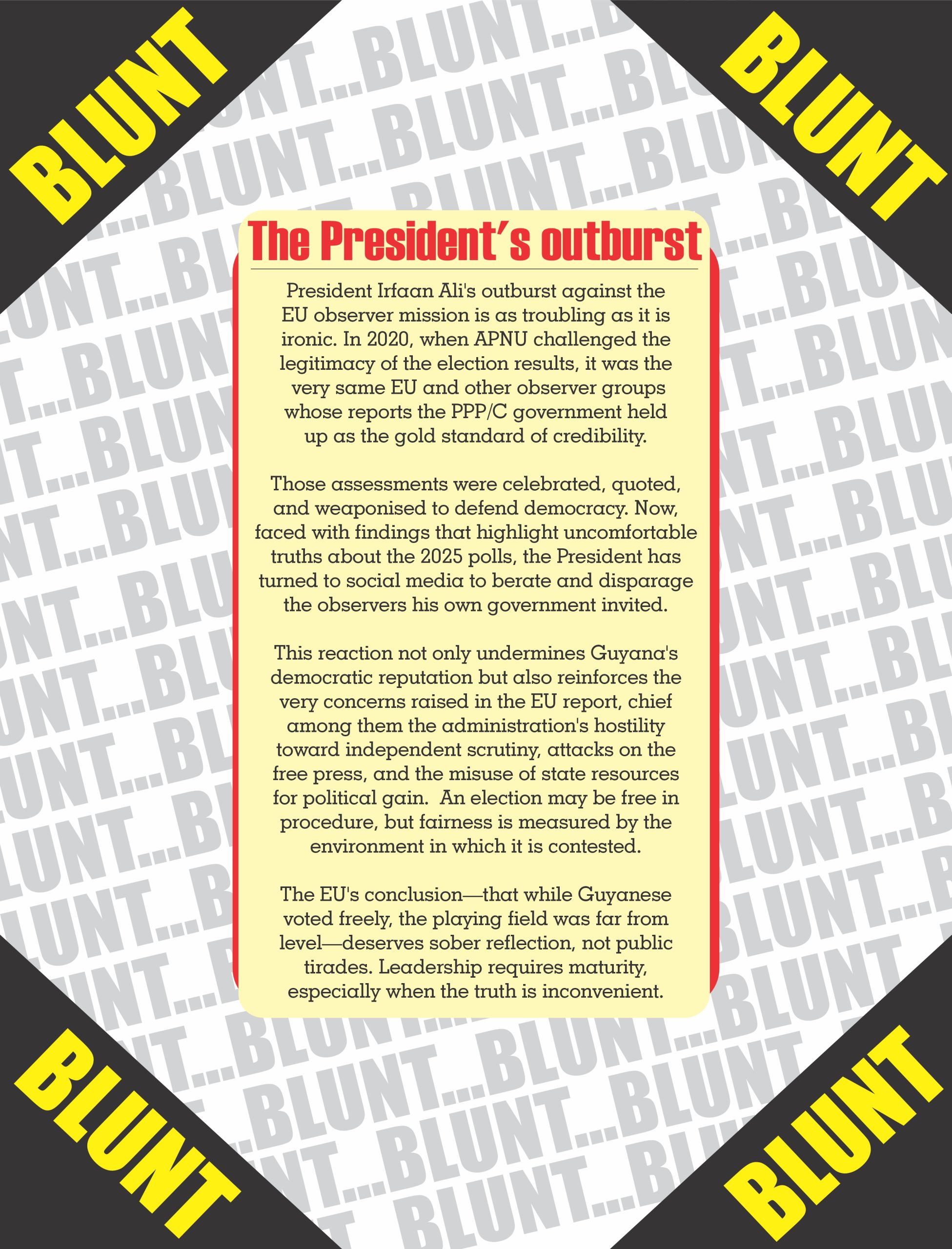
(Kaieteur News) – One could, with the right mix of cynicism have predicted the reaction from the halls of Freedom House to the European Union Election Observer Mission’s Report on this year’s general and regional elections in Guyana. The People’s Progressive Party/Civic, having just...Nov 09, 2025
For the powerful, sovereignty is a sword; for the small, it must remain a shield By Sir Ronald Sanders (Kaieteur News) – Sovereignty is supposedly the cornerstone of international order: the formal declaration that every state has the right to govern itself, protect its territory, and determine...Nov 21, 2025
Hard Truths by GHK Lall (Kaieteur News) – “When you think of 11 billion barrels, big fields get bigger…I would expect upside.” The speaker was Chevron’s Vice Chairman, Mr. Mark Nelson, with his context being Guyana’s legendary Stabroek Block. A vice chair is a Big Kahuna, worth a...Freedom of speech is our core value at Kaieteur News. If the letter/e-mail you sent was not published, and you believe that its contents were not libellous, let us know, please contact us by phone or email.
Feel free to send us your comments and/or criticisms.
Contact: 624-6456; 225-8452; 225-8458; 225-8463; 225-8465; 225-8473 or 225-8491.
Or by Email: glennlall2000@gmail.com / kaieteurnews@yahoo.com