Latest update August 12th, 2026 10:20 AM



Latest News
- After 10 days of silence, Govt. confirms Guyana receiving 50% profit share
- Guyana must get more than 50% if country’s profits will be funding new oil projects – MP Andrews
- MV Barima tragedy… Internal records expose months of warnings, request for urgent repairs
- Colombia quake death toll tops 250 as rescuers race to find survivors
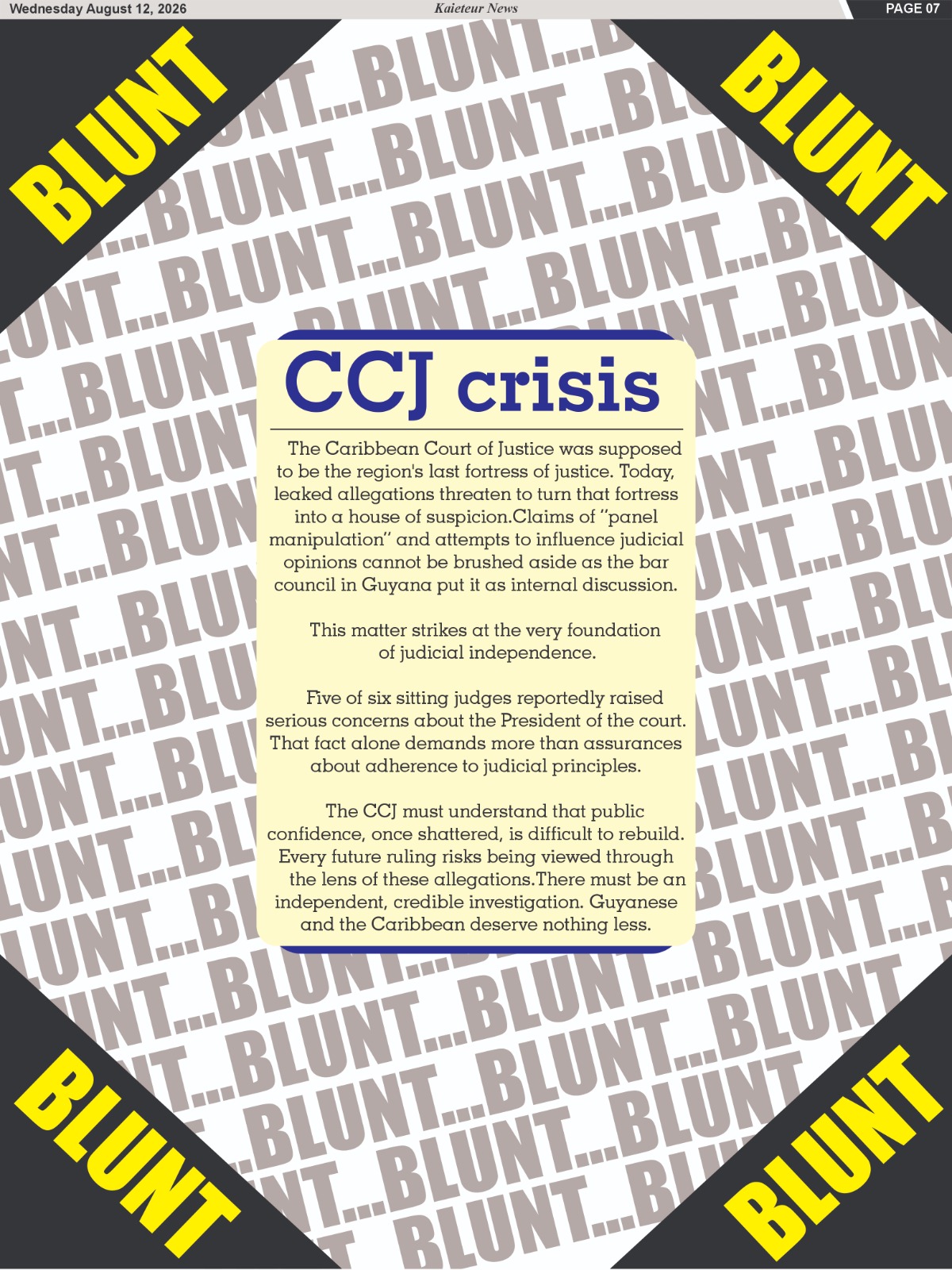
- Caribbean judiciaries rally behind CCJ as internal row erupts
Risk of marrying in the 20s
By Dr. Telford Layne Jr. PsyD, MSc. Postgrad, BSc.
Clinical and Developmental Psychologist – Psychoanalyst
Unwrapping Gift – Clinic
(Kaieteur News) – Many of my clients in their 40s are making the bold decision to seek divorce. Consumed by relationship fatigue, relationship OCD, emotional labour and relationship burnout. Their common refrain is clear: “I married too early and had children too soon. I never achieved the life I envisioned.” They recognise that their marriages have been on life support for far too long. Now, at 45, they are ready to refocus on building a legacy and making a positive impact in the world. With their children now adults, they are determined to remove their marriages from life support and pursue divorce. It is time for a fresh start—returning to school and reclaiming the life they truly desire. With 25 to 30 years or more still ahead of them, they understand the importance of living a meaningful life. This is the reality for many adults in their 40s who married in their 20s.

By Dr. Telford Layne Jr.
The longevity and achievements of a marriage are not a valid measurement of its health. Our childhood experiences fundamentally shape the quality of our relationships and marriages.
Many women from the Baby Boomer and early Generation X, those born between 1965 and 1980, are urging women from Generation X and Y to remain in unfaithful and dysfunctional marriages, claiming it is simply part of men’s nature. They often choose to endure dysfunctional relationships for the sake of their children, believing that staying together in dysfunctional marriages offers a better environment. The significant distortions affect those children’s mental health and relationships.
What is noteworthy, however, is the remarkable rise in divorces among adults between 45 and older, a phenomenon termed “grey divorce.” In fact, women are the ones initiating a staggering 80% of divorces, while men account for only 20%. This means women are more sensitive to relationship challenges than men. Men would rather keep the status quo.
Marriage should be understood not as an achievement, but as a compliment. Historical trends indicate that the average marriage age was in the mid-20s; however, contemporary research suggests that individuals should reconsider the timing of this significant commitment. Evidence demonstrates that marriages occurring in one’s 20s, particularly those contracted before the age of 25, are associated with a substantially higher divorce rate. Studies indicate that approximately 50% of couples who marry between the ages of 20 and 25 experience divorce, with an elevated risk particularly evident within the first five years of marriage. In contrast, individuals who enter marriage after the age of 25 tend to have a markedly lower risk of divorce, as reported by the Journal of Marriage and Family. This data underscores the importance of prioritising personal development and emotional readiness before deciding to marry, ultimately contributing to more stable and enduring relationships.
Several factors contribute to a marital dissolution. A couple may choose to end their marriage in order to safeguard and enhance their mental health while still effectively co-parenting. Sych as lack of commitment, conflict and arguments, financial problems, unrealistic expectations, marrying too young, lack of intimacy, unresolved childhood trauma are underlying all these and more reasons for failed marriages. These conditions originate from abuse, including emotional, mental, physical, and sexual trauma, as well as neglect, financial abuse, spiritual abuse, infidelity, and poor parenting.
A marriage can end in divorce without being deemed a failure if it fulfilled specific objectives, such as raising children, or if the dissolution enables personal development and a more satisfying life for the individuals involved. Conversely, a marriage may be regarded as a failure even if it persists for a lifetime, should it be characterised by ongoing abuse, neglect and generating poor mental health.
The first 18 years of a person’s life are critical; they involve care, nurturing, and the provision of the necessary tools to foster success in adulthood. Presently, life expectancy in Guyana is approximately 70 years. The initial 18 years are spent in a developmental phase under parental guidance, with these formative years serving as a battleground between functional and ineffective parenting. The outcome for children can manifest as healthy, functional adults or as maladaptive individuals who may create a tumultuous adult reality.
The period from ages 18 to 40 is recognised as young adulthood, during which a crucial psychosocial milestone is the establishment and maintenance of healthy intimate relationships with family, friends, and then romantic partners. This stage involves an individual’s ability to be vulnerable—seeking assistance without feeling diminished—and maintaining healthy boundaries to avoid seeking validation through people-pleasing behaviours. A robust self-identity, along with a set of values cultivated during adolescence, coupled with the competencies developed from ages 5 to 12 and beyond, is essential. Moreover, the ability to develop and nurture trust, which entails openness and vulnerability in adulthood, is primarily acquired during the first 18 months of life and further nurtured through later developmental phases.
The frontal lobe, which governs executive functions such as decision-making, planning, and perception, does not mature until approximately age 21. For individuals who have faced severe trauma, complete brain development may not occur until around age 28. It is vital for individuals who endure negative childhood experiences, including various forms of abuse and neglect, to utilise the age range of 18 to 30 for self-discovery and personal development.
Traumatic experiences—such as an absent father, toxic parenting, favouritism, abandonment, abuse, neglect, economic hardship, community violence, racism, and political marginalisation—along with parental issues such as substance abuse. Even a strong single-parent mother has significantly influenced an individual’s thoughts, emotions, and behaviours towards themselves and others. These factors produce mental illness, personality disorders which consist of a range of mental health conditions characterised by pervasive patterns of thinking, feeling, and behaving that deviate markedly from cultural norms, resulting in significant distress or functional impairment in daily life, particularly in interpersonal relationships and professional settings. Comorbid mental health conditions such as anxiety, depression, bipolar disorder, and schizophrenia further complicate the challenges faced in adulthood. Additionally, the presence of attention deficit hyperactivity disorder (ADHD), autism, and other developmental disorders and learning disabilities can render adult life particularly challenging if these issues remain unaddressed.
These disorders, disabilities and mental illnesses have to be addressed. Most people with these challenges rush into committed relationships, not knowing who they are or why specific actions or others trigger them. However, they hope their partner fixes them or they fix their partner. This behaviour by itself is a trauma response originating from emotional neglect in childhood.
To be continued…
Share this:

Discover more from Kaieteur News
Subscribe to get the latest posts sent to your email.
Similar Articles

Blunt of the day
Sports

Features/Columnists

Sir. Ronald Sanders

The GHK Lall Column

Weekend Cartoon