Latest update October 15th, 2026 6:20 AM



Latest News
- Digital evidence emerges as police probe CMC guard’s execution
- Govt. briefs U.S. Justice Dept. on Mohamed shooting incident
- “Gun appeared out of thin air” – lawyer slams police over arrest of Mohamed
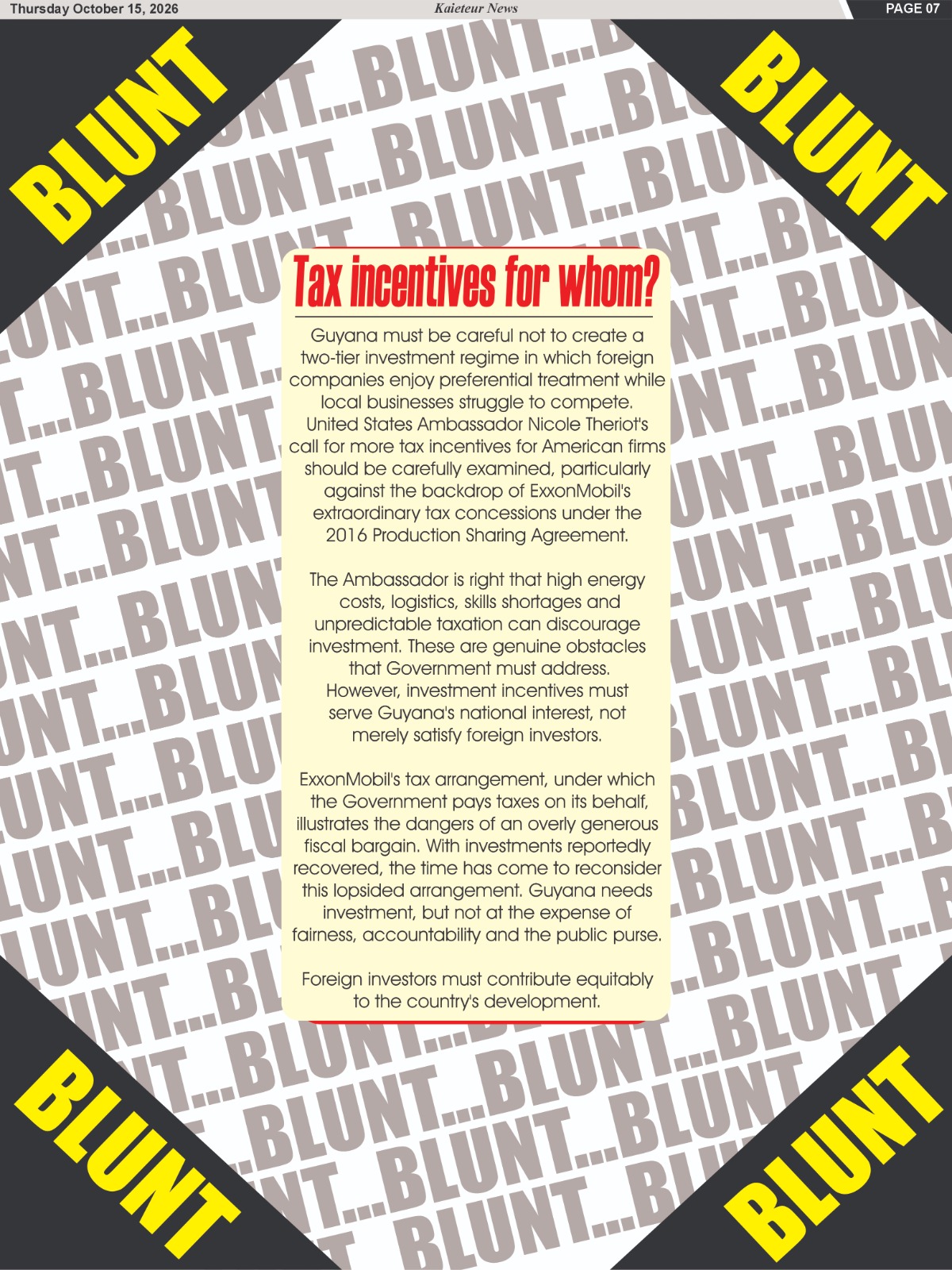
- U.S. wants tax incentives for American firms as Exxon enjoys tax-free deal
- Pope Leo diagnosed with cancer after surgery to remove part of lung
Bhagwandin’s new non-empirical estimate risks misrepresenting the current poverty situation
Dear Editor,
Kaieteur News – I refer to Mr. Joel Bhagwandin’s letter in the July 19, 2025 edition of Stabroek News, where he questions the World Bank’s accuracy of the 2019 poverty rate of 48%. While he raises valid concerns about the use of outdated data, his new non-empirical estimate risks misrepresenting the current poverty situation.
Mr. Bhagwandin argues that in the absence of updated data, anecdotal and economic indicators suggest that the rate of poverty is less than 20% in 2025. He based his non-empirical estimate on the fact that vehicle registrations, private consumption, and net disposable income have all increased. He also pointed to wages of domestic workers, domestic helpers, cleaners, and labourers as further evidence to support his position.
Let me draw a parallel that might help highlight his false inference. According to the Bureau of Statistics, Guyana’s official inflation rate in 2024 was 2.9%. However, consumers faced steep price increases, with the cost of food, clothing, and housing materials rising by more than 10%, and some items increasing by over 30%. At first glance, this seems contradictory, but it’s not. The 2.9% figure is an average across a wide basket of goods and services.
Although some categories saw significant price increases, that does not make the inflation rate inaccurate. It simply reflects how inflation is measured. It can be argued that the basket of goods used to calculate inflation does not accurately reflect the everyday spending patterns or cost burdens faced by most Guyanese households.
Similarly, while increases in vehicle registrations, private consumption, and net disposable income may signal broader economic activity, they do not necessarily indicate a meaningful decline in poverty. It would be misleading to infer from these indicators alone that poverty has significantly decreased.
Findings from a 2024 Inter-American Development Bank (IDB) working paper titled “Ten findings about poverty in Latin America and the Caribbean”, paints a much more realistic picture than Mr. Bhagwandin’s optimistic claims. The IDB Report notes “The countries with highest poverty rates are Venezuela, Honduras, Guatemala, and Guyana, each with more than half of the population in poverty and more than 30% in extreme poverty.” According to this research, 58% of Guyanese are living in poverty (earning less than US$6.85 per day), and 32% are in extreme poverty (earning less than US$3.65 per day). This translates to over 400,000 people living in poverty given a population of just around 800,000. Again, one can argue that another methodology may be more appropriate.
The IDB Report also highlights that more than two-thirds of people living in extreme poverty are located in rural areas, highlighting a sharp geographic disparity in poverty distribution across Guyana. The Report shows that among those living in extreme poverty, 25% are children aged 0 to 14, 68% are adults aged 15 to 64, and 7% are seniors aged 65 and over. It also found that 53% of the extremely poor are women. We cannot overlook the intersection of race, gender, geography, and age in the structure of poverty.
Mr. Bhagwandin argues that workers like domestic helpers and security officers earn more than US$5.50 a day. Income snapshots also don’t account for, among other things, household size. For instance, a labourer earning G$5,000 a day might be supporting multiple dependents. The same can be said for vehicle ownership. Are the new vehicles broadly distributed, or are they heavily concentrated among wealthier households?
It is entirely fair to challenge the methods of international institutions. However, intellectual honesty demands that we also confront uncomfortable truths. Guyana’s economy has grown dramatically in recent years. That’s a fact. Another fact is that too many people, especially children, rural families, and marginalized communities, are not seeing the benefits of that growth.
The IDB Report acknowledges significant differences between its poverty estimates for Guyana and those of the World Bank, due to the two institutions relying on different data sources. The IDB used recent Labor Force Surveys, while the World Bank relied on much older data. Given the economic and demographic changes, the IDB’s estimates, based on more recent data, likely provides a more accurate view of current poverty levels. Nevertheless, both sources acknowledge that poverty remains a major issue in Guyana.
Data-driven decision-making is always better than guesswork. Instead of dismissing the statistics as outdated or inaccurate, we should call for updated, transparent poverty data. Ignoring the facts in favour of anecdotes or selected indicators not only distorts the truth but also disregards the lived experiences of hundreds of thousands of Guyanese. The national conversation on poverty must be rooted in evidence, empathy, and practical solutions, not denial. Acknowledging the problem is the first step toward solving it. Without recognizing the depth and scale of extreme poverty, we risk designing policies that leave behind the very people who need help the most.
Sincerely,
Elton Bollers
Share this:

Discover more from Kaieteur News
Subscribe to get the latest posts sent to your email.
Similar Articles
Website Hits

Blunt of the day
Sports

Features/Columnists

Sir. Ronald Sanders

The GHK Lall Column

Weekend Cartoon



