Latest update September 9th, 2026 10:25 AM


Latest News
- ‘Deportee deal under fire’ …as govt. faces calls to publish agreement signed with U.S.
- Guyana already paying for Exxon’s 8th and 9th oil projects – Former EPA Head
- No salvager for MV Barima 26 days after tender
- UK, France among 12 states backing sanctions on illegal Israeli settlements
- ‘Guyana lagging behind in digital trade race’ — World Bank, IDB, WTO Report
Playing both side of the flute can leave one muzzled
Kaieteur News – In Guyana, one finds a curious paradox that might amuse, bemuse, or even confound the casual observer: the bourgeois class, the very group whose fortunes have been pulverized by successive governments led by the People’s National Congress (PNC), the People’s National Congress Reform (PNCR), and the A Partnership for National Unity + Alliance For Change (APNU+AFC) coalition, continues to be one of the staunchest supporters of these very parties. It’s a paradox wrapped in the finest silk of self-interest, yet embroidered with the threads of political insurance that often unravel at the worst possible moment.
The bourgeoisie class seems to have mastered the art of playing both sides of the political divide. Their wealth affords them the privilege of straddling the fence, financing the ruling People’s Progressive Party/Civic (PPPC) while simultaneously sliding thick envelopes into the pockets of the main opposition parties. This strategy is steeped in the pragmatic logic of ensuring one’s survival regardless of which party emerges victorious. But it speaks to a deeper, more cynical understanding: elections are not about principles but about preservation.
This dance with political duality, however, comes with a cost—a cost that the bourgeoisie appears all too willing to pay. For all their cunning and calculation, this class suffers disproportionately whenever the opposition parties they support refuse to accept the democratic will of the people, plunging the country into uncertainty and economic turmoil. Yet, despite the bruises and battering they endure under such regimes, this class seems unable—or unwilling—to break free from this cycle.
It’s a tale as old as time, or at least as old as modern democracy. The bourgeoisie, the very engine of the economy, finds itself in the peculiar position of being both the puppet and the puppeteer. They pull the strings by funding political campaigns, securing favours, and currying favour with whoever sits on the throne. But when the opposition—those same parties whose coffers they have filled—chooses to disregard the results of a free and fair election, it is this class that suffers the most. Businesses falter, investments dry up, and the economy teeters on the brink. Yet, like the moth to the flame, they return to their destructive dalliance come the next election cycle, envelopes at the ready.
One might argue that this behaviour is not unique to Guyana. In many parts of the world, the wealthy and the powerful hedge their bets, ensuring that they maintain influence regardless of which political faction gains power. But in Guyana, the situation is especially stark. The country’s history is replete with examples of how political instability, often stoked by opposition parties unwilling to concede defeat, has led to economic hardship. And it is the bourgeoisie—those who have the most to lose—that ends up paying the price.
Yet, this class seems almost oblivious to the lessons of history. Or perhaps they are simply too entrenched in their ways, too accustomed to their strategy of playing both sides, to change course. They seem to believe that by spreading their wealth across the political spectrum, they can insulate themselves from the consequences of political upheaval. But this belief is as fragile as it is misguided. The reality is that when the political system is thrown into disarray, when the legitimacy of the government is called into question, it is the bourgeoisie’s investments, businesses, and properties that are the first to feel the impact.
There is a certain irony in this situation. The bourgeois class, which prides itself on its shrewdness and business acumen, continually acts in a manner that is detrimental to its own interests. They support parties that have historically undermined the very stability and economic growth that they rely on. And when these parties, once again, disrupt the political order, the bourgeoisie finds itself scrambling to protect its assets, to mitigate the damage that it helped to cause.
Yet, despite this, there is little doubt that when the next election rolls around, the same envelopes will be prepared, the same donations made, and the same strategy employed. For in the minds of the bourgeoisie, political insurance trumps all else. It is a hedge against uncertainty, a safeguard against the vagaries of electoral politics. But it is also a trap, one that keeps this class locked in a cycle of self-inflicted harm.
This paradox is not lost on the keen observer. The bourgeoisie’s actions, while seemingly rational in the short term, are ultimately self-defeating. They are trapped in a loop of their own making, one where the pursuit of political insurance leads to greater instability, which in turn necessitates even more insurance. It is a cycle that can only end when the bourgeois class realizes that its true interests lie not in playing both sides, but in supporting the principles of democracy and the rule of law.
Until that realization dawns, however, one can expect the envelopes to keep circulating, the donations to keep flowing, and the cycle to continue. The bourgeoisie will continue to straddle the political divide, financing both the PPPC and the opposition in the hope of securing their place in the sun. But as history has shown, this strategy is fraught with peril. For in the end, it is not just the economy or the political system that suffers—it is the bourgeoisie itself, caught in a paradox of its own making, that bears the brunt of the fallout. And yet, come the next election, the envelopes will be ready, as they always are, a testament to the enduring, if ultimately self-destructive, logic of political insurance.
(The views expressed in this article are those of the author and do not necessarily reflect the opinions of this newspaper.)
Share this:

Discover more from Kaieteur News
Subscribe to get the latest posts sent to your email.
- governments, Peeping Tom, People's National Congress (PNC), People’s National Congress Reform (PNCR), People’s Progressive Party/Civic (PPPC)
Similar Articles
Website Hits

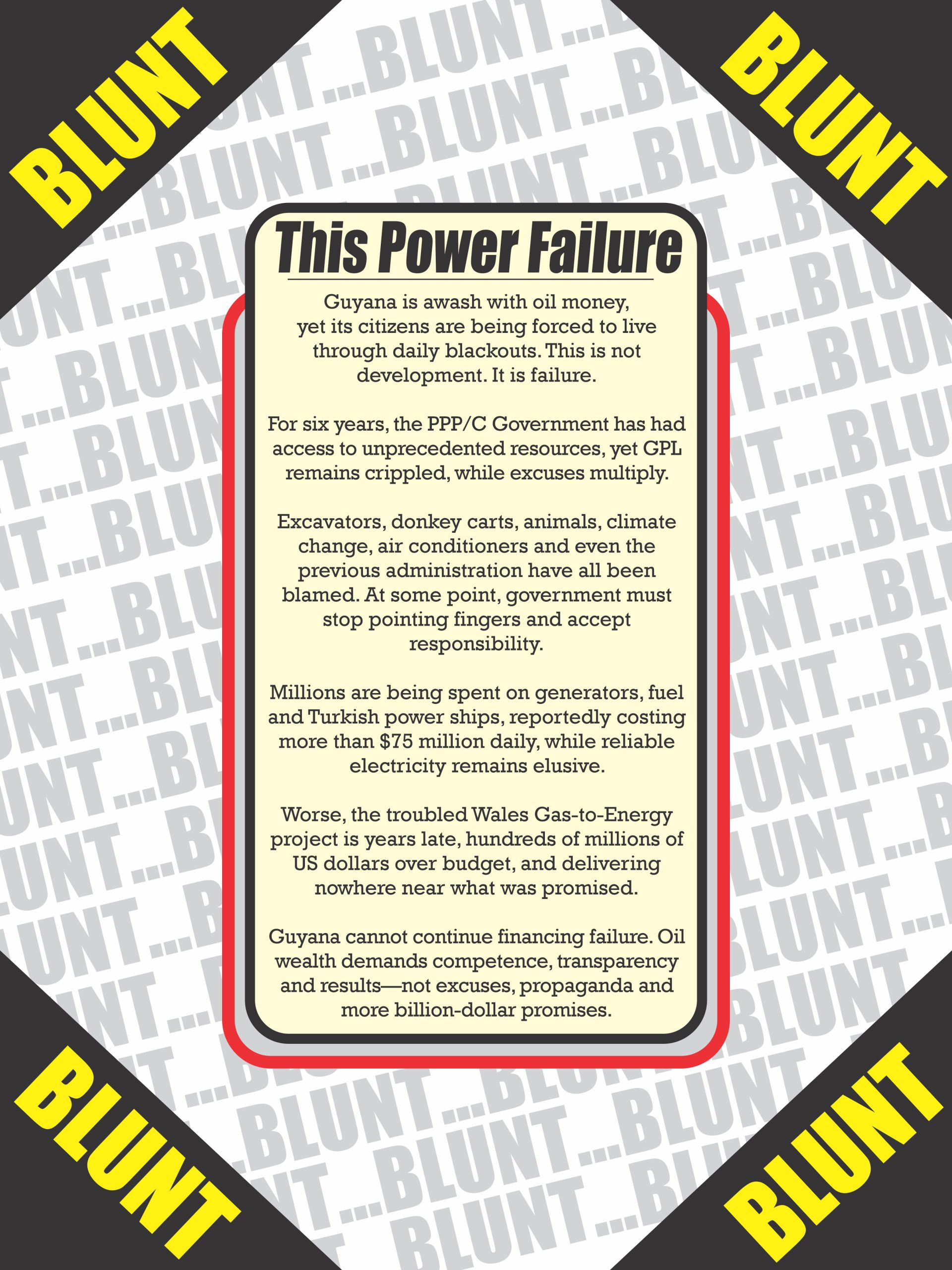
Blunt of the day
Sports

Features/Columnists

Sir. Ronald Sanders

The GHK Lall Column

Weekend Cartoon