Latest update October 8th, 2026 10:30 AM



Latest News
- BK wins $1.3B contract to salvage MV Barima
- Exxon to repair gas-to-energy pipeline off Crane
- ‘Who is responsible?’ — Barima COI Chairman vows to follow evidence wherever it leads
- Maduro to face new U.S. charges over alleged torture of Americans, official says
- President Ali blasts visa barriers, says Caribbean cannot build tourism with ‘stone age’ system
Ram wants constitution reform commission scrapped
…says two years on, millions spent and little to show
(Kaieteur News) – Attorney-at-law and Chartered Accountant, Christopher Ram is calling for the immediate termination of the Carl Singh-led Constitution Reform Commission, arguing that after more than two years, substantial public expenditure and continuous remuneration, the body has produced little and remains barely beyond the starting point set by Parliament.
Ram, in a letter to the editor dated 23rd August, 2026, said the Commission’s recent invitation for written submissions until 31st December represents the first stage of public consultation—nearly four years after the Constitution Reform Commission Act was passed and more than two years after the Commission was sworn in.
He described the pace of the exercise as unacceptable.
“This is not a snail’s pace. The snail, at least, keeps moving towards its destination,” Ram said. According to Ram, the matters now being placed before the public are substantially the same as the mandate Parliament gave the Commission in 2022.“This means that nearly four years after the Act and more than two years after the Commission was sworn in, it has arrived at the starting point Parliament prescribed for it,” he said.
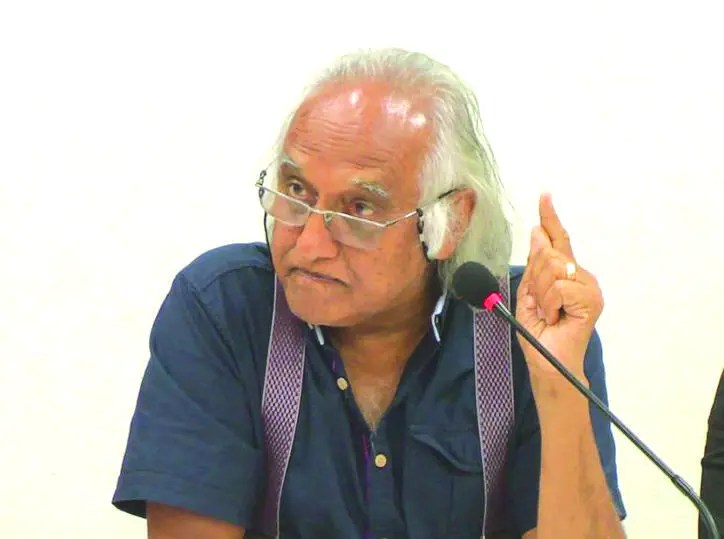
Attorney-at-law, Christopher Ram
Ram contrasted the performance with that of the 1999 Constitution Reform Commission, which, despite operating under intense political pressure following the 1997 elections and the Herdmanston Accord, completed its substantive work in roughly six months.
That Commission considered about 4,600 proposals from individuals and organisations across Guyana, held public hearings, consulted experts and produced 171 recommendations by July 1999. “In roughly six months, under far greater political pressure and under the chairmanship of Mr. Ralph Ramkarran, S.C., the 1999 Commission substantially completed an exercise which the Carl Singh-led Commission, after more than two years, has barely begun,” Ram wrote.
Ram said the current Commission’s slow pace is even more troubling given the resources placed at its disposal. He said hundreds of millions of dollars in public funds have been allocated to constitutional reform and its supporting machinery and called for a full accounting of how the money has been spent.
Ram said he understands that the Chairman receives $1.3 million monthly, the Vice-Chair $500,000, each Commissioner $200,000 and the Secretary $600,000. He also raised questions over payments made during the four-month recess for the 2025 elections campaign.
Ram said Commission members accepted payment during the period, while Chairman Singh later acknowledged publicly that attendance by Commissioners had been a problem. “Knowingly accepting public money for work one does not perform strikes me as conduct of an altogether different order from mere absenteeism,” Ram said.
He called on Attorney General Anil Nandlall and the Minister responsible for Finance to publish a full accounting of expenditure and remuneration. At the same time, he urged the Commission to publish its meeting records, attendance, research undertaken and substantive work produced.
Ram also questioned whether the Commission still reflects the political configuration of the country following the 2025 elections. He highlighted the absence of representatives from WIN, which now holds 16 parliamentary seats and is the principal Opposition party. At the same time, he pointed out that a representative of the Joinder parties—ANUG, the Liberty Justice Party and The New Movement—remains on the Commission, although none of those parties is represented in the current National Assembly.
“WIN, with sixteen seats and now the principal Opposition party, has no representative at all,” Ram said.
He noted that Nandlall himself acknowledged the problem in October 2025, saying the legislation establishing the Commission had been drafted for the previous parliamentary configuration and that amendments were being prepared to reflect the new Opposition arrangement. Ram questioned why the Commission is now proceeding with public consultation before that acknowledged defect has been corrected.
He warned that this could create a serious problem further down the road, since any recommendations produced by the Commission will ultimately have to be considered by Parliament, where WIN’s support could be critical. “The Commission is therefore attempting to devise constitutional reform without the principal Opposition party, only eventually to send its proposals to a National Assembly in which that party’s support may be indispensable,” he said.
Ram also criticised the Commission for failing, so far, to demonstrate what lessons have been drawn from the 1999 constitutional reform exercise. He said the Commission should have assessed what recommendations from the 1999 report were implemented, what failed, what worked and why.
He further argued that Guyana’s transformation into a major oil-producing country has created new constitutional questions surrounding natural resources, intergenerational equity and accountability for national wealth. Among the other issues he believes require attention are the concentration of presidential power, presidential immunity, inclusionary democracy, constitutional appointment deadlocks, GECOM’s partisan architecture, parliamentary oversight and local government autonomy.
But Ram’s strongest recommendation is that the current Commission should not be allowed to continue in its present form. “The question therefore is no longer whether this Commission needs more time. It is whether it should be permitted to continue in its present form,” he said.
“In my view, it should not.”
Ram is proposing that the current exercise be ended and that responsibility for constitutional reform be returned immediately to Parliament’s Standing Committee for Constitutional Reform. He said the committee would better reflect the current composition of the National Assembly and could move the process forward transparently, with expert and civil-society participation, within a firm timetable and with proper accountability for public spending. Ram concluded that, by any reasonable measure—including the “time-bound and assignment-bound” standard previously articulated by Attorney General Nandlall—the Carl Singh-led Commission has failed. “On the application of any reasonable test—including the Attorney General’s own metric—the Carl Singh-led Constitution Reform Commission is already a colossal failure,” Ram said.
Share this:

Discover more from Kaieteur News
Subscribe to get the latest posts sent to your email.
Similar Articles
One thought on “Ram wants constitution reform commission scrapped”
Website Hits

Blunt of the day

Sports
Features/Columnists

Sir. Ronald Sanders

The GHK Lall Column

Weekend Cartoon


This definitely need to be scrapped.
Receiving pay for no work is stealing from the employer.
That pay dished out should be refunded back to employer.