Latest update September 25th, 2026 10:30 AM


Latest News
- ‘Visa restrictions, acting appointments are modern pressures on judicial independence’ — Justice Abel
- Pres. Ali makes direct appeal to P5 for Rodrigues as next UN chief
- Delegates walk out on Netanyahu at UN
- Teen drowns while crossing Siparuni River
- Criminal networks now operating like corporations – INTERPOL chief tells Guyana confab
CCJ clears way for extradition case to proceed in Magistrates’ Court
(Kaieteur News) – The Caribbean Court of Justice (CCJ) has cleared the path for United States (U.S.) extradition proceedings against Guyana’s Opposition Leader Azruddin Mohamed and his father, prominent businessman Nazar ‘Shell’ Mohamed, to move forward.
In a judgment delivered on Wednesday (CCJ Application No. GYACV 001 of 2026), the Trinidad-based regional appellate court unanimously dismissed the Mohameds’ substantive appeal against the Minister of Home Affairs, the Attorney General, and Principal Magistrate Judy Latchman.
The ruling formally lifts an interim stay imposed on March 25, 2026, allowing committal proceedings to resume before Principal Magistrate Latchman in the Georgetown Magistrates’ Court. While the court granted special leave to appeal, it ultimately dismissed the substantive challenge and ruled that each party must bear their own legal costs. The bench noted that no costs were awarded to the government because the proceedings sat at the intersection of public and criminal law, served a significant public interest, and brought critical clarifications to the law.
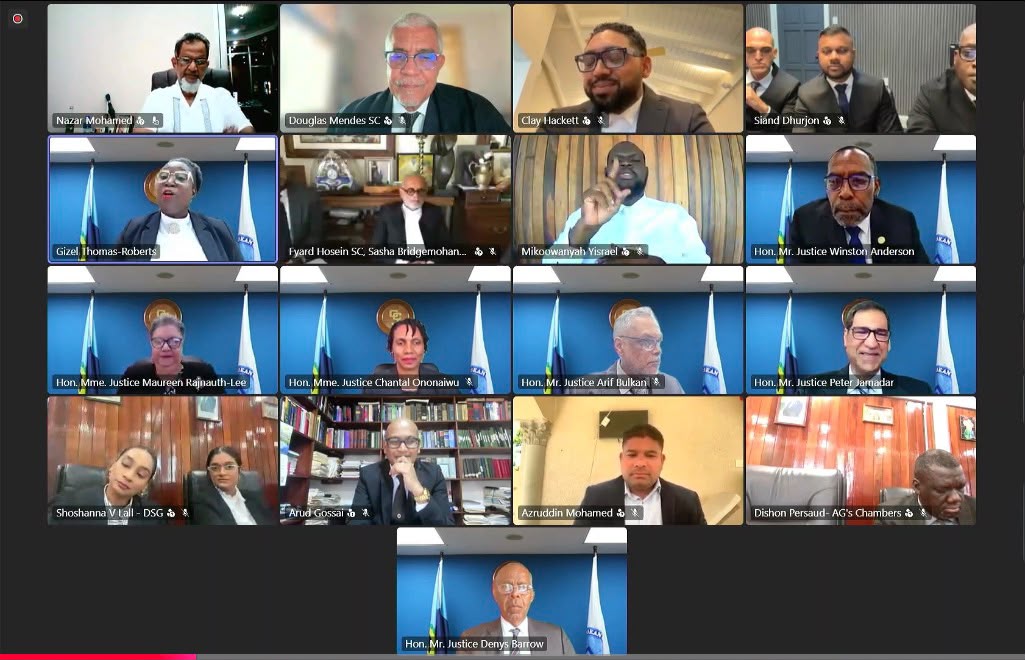
The CCJ cleared the way for extradition case against the Mohamed to proceed in Magistrates’ Court.
Court rebukes officials, cites apparent bias
Despite the appeal’s dismissal, the landmark 256-page judgment contained sharp rebukes for high-ranking government officials and overturned key legal premises previously upheld by Guyana’s High Court and Court of Appeal.
The regional court rejected arguments presented by Attorney General Mohabir Anil Nandlall, SC, which claimed that the rule against bias could not apply to a Minister’s issuance of an Authority to Proceed (ATP), and that the judicial review application was premature. Justices Rajnauth-Lee, Jamadar, and Bulkan ruled there was “no basis in law” preventing the applicants from seeking judicial review at the start of extradition proceedings, noting “pragmatic good sense” in raising bias allegations early.
Furthermore, the CCJ addressed public statements made by Nandlall and Vice President Bharrat Jagdeo. Justices Rajnauth-Lee, Jamadar, and Bulkan determined that the Attorney General’s public remarks crossed the threshold into apparent bias, stating his comments ran “afoul of constitutional imperatives” regarding the presumption of innocence. However, the court ultimately concluded this apparent bias did not sufficiently contaminate the Minister of Home Affairs’ decision to invalidate the ATP. In separate opinions, Justices Ononaiwu and Eboe-Osuji, along with the broader bench, issued strong warnings against public commentary by executive leaders that could exert undue political pressure or undermine the independence of the judiciary.
Following the decision, the legal team representing the Mohameds, comprising Senior Counsel Roysdale Forde, Siand Dhurjon, and Damien Da Silva, released a public statement acknowledging the judgment.
While noting the ultimate dismissal of the appeal, the defense highlighted the ruling as a victory for constitutional rights and procedural fairness in extradition matters across the Commonwealth Caribbean.
“The judgment represents a significant clarification of the law governing extradition proceedings in Guyana and the Commonwealth Caribbean. The Court has resolved several important legal questions in the Applicants’ favor and, in doing so, has corrected material errors made by both the High Court and the Court of Appeal,” the defense statement read.
The defense counsel also confirmed that the CCJ intends to convene further hearings to determine whether previous costs orders levied against the Mohameds by Guyana’s lower courts should be maintained or overturned. With the interim stay now lifted, all eyes return to the Georgetown Magistrates’ Court as the extradition committal process gets underway.
Background to the legal battle
The legal battle stems from general elections held in Guyana on September 1, 2025, in which Azruddin Mohamed was elected as Leader of the Opposition before taking his oath of office in January 2026. On October 28, 2025, the United States government formally requested the extradition of both men to face an 11-count criminal indictment alleging conspiracy, mail and wire fraud, and money laundering.
Two days later, on October 30, 2025, Minister of Home Affairs Oneidge Walrond issued an Authority to Proceed (ATP) under Section 12 of the Fugitive Offenders Act, directing the magistrate to proceed with committal hearings.Principal Magistrate Judy Latchman issued arrest warrants the following day, formally initiating court proceedings.
In December 2025, the Mohameds launched judicial review proceedings in the High Court seeking to quash the ATP and stay the committal hearings. They contended that Minister Walrond’s decision was tainted with bias due to her affiliation with the governing People’s Progressive Party/Civic (PPP/C), whose top leadership, including the President, Vice President, and Attorney General, had publicly referred to them in derogatory terms during the election campaign. They also argued that the ATP was defective because the Minister had consulted with the Attorney General, whom they alleged was also biased.
Dismissals in domestic courts
Chief Justice Navindra Singh dismissed the application in the High Court on February 4, 2026, ruling that the Minister exercised an executive rather than a judicial function, meaning the rule against bias did not apply in full. He added that comments by cabinet colleagues could not be attributed to the Minister to taint her decision.
The Court of Appeal upheld that dismissal on March 17, 2026, finding that issuing an ATP was an administrative function where bias did not arise, and that a fair-minded observer would recognise the ATP as merely a preliminary step.
The Mohameds then appealed to the CCJ, which granted an interim stay on March 25, 2026, and heard the substantive appeal on April 21, 2026. The full panel comprised CCJ President Mr. Justice Winston Anderson, Mr. Justice Denys Barrow, Madam Justice Maureen Rajnauth-Lee, Mr. Justice Adrian Saunders, Mr. Justice Peter Jamadar, Mr. Justice Arif Bulkan, Justice Chantal Ononaiwu, and Mr. Justice Chile Eboe-Osuji.
Senior Counsel Mr. Fayyad Hosein and Senior Counsel Mr. Roysdale Forde, alongside attorneys Siand Dhurjohn, Sasha Bridgemohan Singh, Damien Da Silva, and Adam Hussein, appeared for the Mohameds. Senior Counsel Douglas Mendes and Clay Hackett appeared for Minister Walrond; Attorney General Mohabir Anil Nandlall, SC, Solicitor General Nigel Hawke, Shoshana Lall, Deshaun Prasad, and Joshua Cullen appeared for the AG; while separate counsel represented Magistrate Latchman.
Threefold court ruling
The apex court delivered three separate judgments detailing its decision. In the lead joint opinion authored by President Anderson and Justice Barrow, the court held that while the rule against bias does apply to the ministerial grant of an ATP, the process does not import the full panoply of procedural rights available in judicial trials.
Delivering the lead judgment, Justice Barrow noted:
“The ATP process does not import the full panoply of procedural rights available in judicial proceedings. There was no general right to be heard prior to the issuance of the ATP. There was no requirement for the minister issuing the ATP to be free from political bias. What was required was for the minister to engage in a process that allowed for consideration of the factors contemplated by the Act.”
The lead judges emphasised that the applicants had not alleged that the Minister failed to consider relevant factors or acted on irrelevant ones, relying solely on allegations of political bias.
President Anderson and Justice Barrow also expressed the considered view that challenges to an ATP on grounds of bias should generally be heard only after committal proceedings are completed before a magistrate, preventing unnecessary delays in extradition treaties. Justice Barrow further expressed “grave doubts that there could properly be delegation of the powers under the Act to issue the ATP to any person who was not a minister.”
In a second opinion, Justices Rajnauth-Lee, Jamadar, and Bulkan held that challenging an ATP for bias at an early stage was not premature and made pragmatic good sense. While finding no appearance of bias against Minister Walrond, they noted a real possibility of apparent bias regarding Attorney General Nandlall, but concluded his involvement did not so contaminate the administrative process as to invalidate the Minister’s ATP.
Crucially, Justices Rajnauth-Lee, Jamadar, and Bulkan issued a stern rebuke regarding executive commentary on active court matters, stating: “Public statements by the Vice President and the Attorney General referencing the existing judicial proceedings can undermine the independence of the judiciary and have deleterious effects on the administration of justice and the rule of law in Guyana. They are to be denounced.”
In the third opinion of Justices Eboe-Osuji and Ononaiwu, the court observed that bias must be assessed objectively from the viewpoint of a fair-minded, reasonable observer fully informed of all material facts, including foreign indictments and international treaty obligations that leave little room for ministerial refusal.
Addressing the standard of assessment and the second applicant’s conduct, Justice Eboe-Osuji in the ruling stated:
“Fairness must attend decisions in public office and fairness abjures bias, but the law chooses the blinkered view in the appraisal of bias… Bias is assessed from the point of view of the fair-minded, reasonable observer fully informed of all the material facts and circumstances.”
Justice Barrow added:
“On the facts and circumstances of the present case, the second appellant (Azruddin Mohamed) does not have clean hands. He provoked verbal attacks against him by his own early attacks against government officials or his own willing participation in a general brawl of political calumny.”
President Anderson concluded the hearing by thanking all counsel for their extensive written and oral submissions in the complex matter:
“We will then consider those comments, perfect the judgment for uploading to the website of the court by 4 p.m. on Friday. The judgment having been delivered, there is no embargo on disclosure… I would like to make the comment of expressing the gratitude of my colleagues and myself to counsel for their very considerable assistance to us in this matter.”
Extradition proceedings to resume at Magistrates’ Court
With the CCJ’s lifting of the interim stay, extradition proceedings will now move forward before Principal Magistrate Judy Latchman in Georgetown to determine whether the evidence submitted by the United States justifies committing the father and son for extradition.
Share this:

Discover more from Kaieteur News
Subscribe to get the latest posts sent to your email.
Similar Articles
Website Hits

Blunt of the day

Sports

Features/Columnists

Sir. Ronald Sanders

The GHK Lall Column

Weekend Cartoon