Latest update March 12th, 2026 9:56 PM

Dec 22, 2025 Letters
Dear Editor,
There is a persistent paradox at the heart of contemporary Caribbean emancipatory discourse, namely, the notion of the Caribbean itself may be, in significant respects, a colonial construction. The idea of a coherent Caribbean space emerged historically through colonial political administration, plantation economies, imperial historiography, European travel writing, and systems of governance designed for extraction and control.
The question, then, is unavoidable: when Guyana today seeks to deepen its “Caribbean‑ness”, whether through institutions, sport, music, economic integration, or diplomatic alignment, is this a radical departure from colonial history, or does it risk being a continuation of colonial categories under post‑colonial management and an eerie resurrection of the ghost of “massa”?
This concern is not merely theoretical. The Caribbean was not born as a self‑defined civilisational unit. It was assembled through European logics that grouped disparate societies according to trade routes, labor regimes, and imperial convenience.
Guyana’s inclusion itself reflects this history. Geographically South American, ecologically continental, and culturally plural, Guyana was administratively folded into the British West Indies largely because of language, law, and colonial governance, not because of geography or pre‑colonial cultural continuity.
From this perspective, the drive toward continuous Caribbean integration appears contradictory, especially when framed as part of a broader effort to escape colonial legacies. If the category “Caribbean” is itself a colonial artifact, then uncritical attachment to it risks reproducing inherited limits on political and cultural imagination.
Cricket diplomacy, Carnival circuits, CARICOM bureaucracy, and regional summitry can become rituals of belonging those obscure deeper asymmetries in development, infrastructure, and strategic interest. For example, while island states focus on tourism‑led economies and maritime vulnerabilities, Guyana’s growth trajectory is increasingly shaped by continental trade corridors, hinterland development, energy infrastructure, and extractive industries.
Yet this contradiction is not irresolvable. Caribbean identity has never been only a colonial imposition. It has also been reworked from below through anticolonial struggle, cultural creativity, and intellectual labor. Caribbean literature, music, and political thought have long transformed the memory of captivity into languages of resistance and survival.
To participate in Caribbean institutions, therefore, is not automatically to surrender to colonial inheritance. The problem arises when Caribbean identity is treated as an endpoint rather than a tool, as a fixed destiny rather than a strategic affiliation. This is where the question of geography becomes decisive. Guyana’s future is not only cultural or diplomatic, it is physical, environmental, and spatial. The country’s population, infrastructure, and administrative core remain concentrated on a narrow coastal plain that lies at or below sea level.
This is not an abstract vulnerability. Rising sea levels, saltwater intrusion, intensified rainfall, and aging colonial drainage systems already threaten housing, agriculture, and public health. The historic sea defenses that once symbolised colonial engineering prowess now expose the fragility of our inherited spatial arrangements. If climate change forces us to rethink where and how Guyanese live, then it must also force us to rethink how Guyana situates itself regionally. A long‑term vision that remains psychologically and institutionally northward‑looking risks ignoring the continental realities to the south and west. Turning South offers not only physical high ground but also alternative economic imaginaries, integrated river systems, overland connectivity, and regional climate adaptation frameworks better aligned with Guyana’s terrain and scale.
In this sense, a Southern turn is not a rejection of Caribbean culture or history. It is a rebalancing of perspective. Caribbean affiliation will remain one layer of identity and cooperation, but it must not confine strategic thinking. A future‑oriented Guyana must learn to operate simultaneously within Caribbean cultural space and South American geographic reality, without allowing either to harden into dogma.
The deeper decolonial task, then, is not to choose between Caribbean belonging and post‑colonial autonomy, but to refuse inherited categories as limits. Decolonisation is not achieved by abandoning institutions, but by interrogating their origins, testing their usefulness, and refusing to let them define the horizon of possibility. In an era of climate uncertainty and geopolitical realignment, Guyana’s survival and sovereignty will depend less on symbolic belonging and more on spatial intelligence, environmental foresight, and the courage to imagine a geography of the future that history did not design for us.
Sincerely,
Dr. Walter H. Persaud
Subscribe to get the latest posts sent to your email.
Your children are starving, and you giving away their food to an already fat pussycat.
Mar 12, 2026
2026 Commissioner of Police T20 Cut Round 1… Kaieteur Sports – Led by a classy fifty from Kevlon Anderson, the Presidential Guards sped to an easy 7-wicket victory over the GPF Academy...Mar 12, 2026
(Kaieteur News) – In the latest twist in the political narrative of the country’s Opposition, there is an unvarnished attempt to suggest that under the leadership of the PNCR during the period 2015 to 2020, the party’s support base was neglected. Nothing could be further from the truth. The...Mar 08, 2026
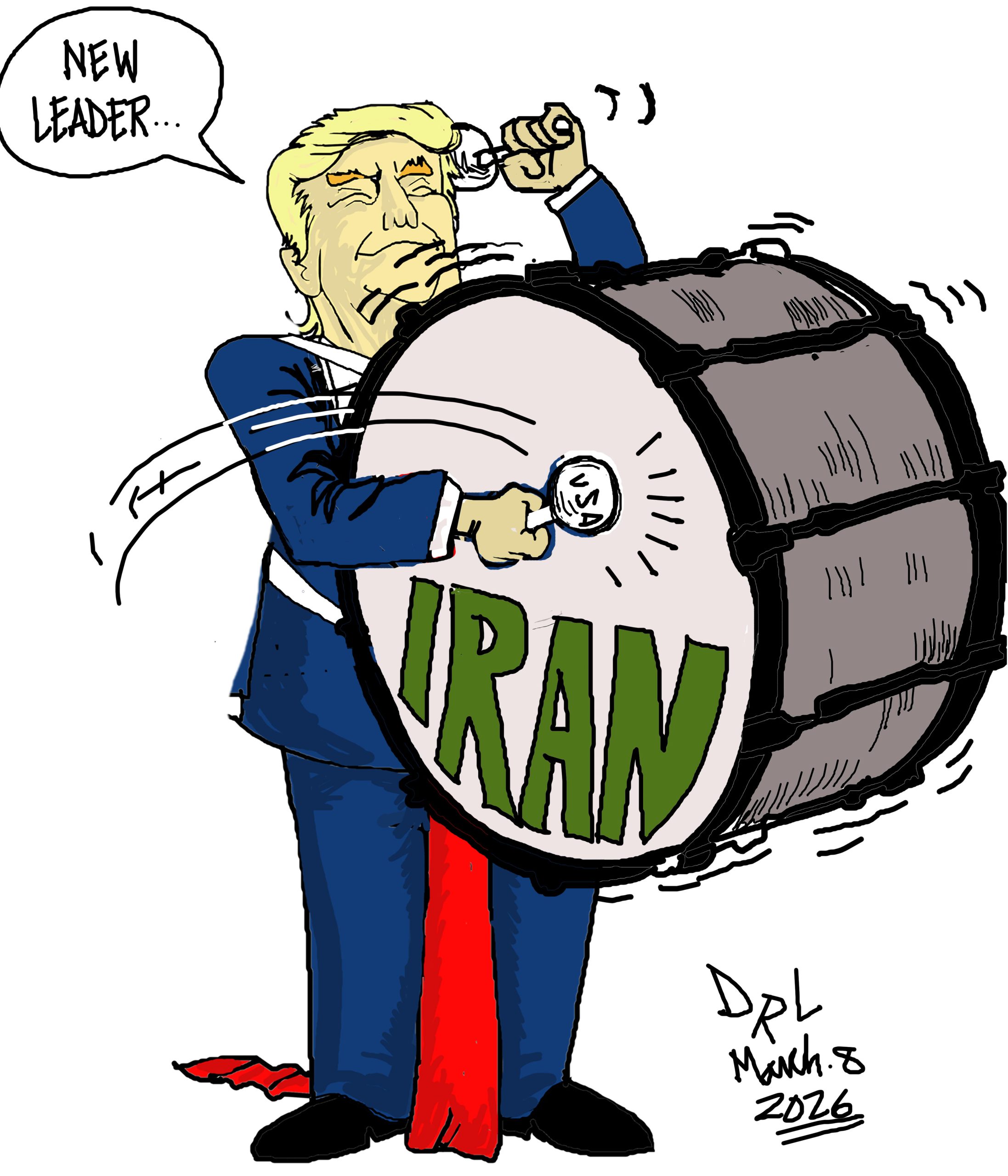
By Sir Ronald Sanders (Kaieteur News) – It is a mistake to believe that the war in Iran and the retaliatory actions in the Gulf are too far away to matter to the Caribbean. The fallout is already reaching the region, pushing up the costs of fuel, freight, and everyday goods across the region....Mar 12, 2026
(Kaieteur News) – The PPP went from ideology to lust for power then love of money. The connecting thread was abject surrender to slavery. From Marxism to socialism to capitalism. The latter is about free enterprise. Alongside free enterprise, there is an endless list of sacred freedoms. ...Freedom of speech is our core value at Kaieteur News. If the letter/e-mail you sent was not published, and you believe that its contents were not libellous, let us know, please contact us by phone or email.
Feel free to send us your comments and/or criticisms.
Contact: 624-6456; 225-8452; 225-8458; 225-8463; 225-8465; 225-8473 or 225-8491.
Or by Email: glennlall2000@gmail.com / kaieteurnews@yahoo.com