Latest update September 24th, 2026 10:31 AM


The Guyana National Assembly should pass the Protected Disclosures Bill (‘Whistle-blowers Bill’)
Dear Editor,
In every country, there are varying degrees of corruption, not just in government and the public sector, but also in the private sector, in civil society organizations, and also in international development agencies.
In a 2013 Gallup International Survey of 70,000 persons from 69 countries, corruption was identified as the world’s number one problem. In a 2014 World Economic Forum Survey of 1,000 young people (18 to 34 years) from 102 countries, 72% believed that corruption is “holding back their country.”
In contrast, there are people who ignore, downplay or deny that corruption is a significant problem. They incorrectly believe that “it is human nature, it is how business and politics work, and, it is not a major issue because there is no massive public outcry.”
Consequently, they argue that preventing corruption is an impossible task because, even in many countries where there are state-of-the-art laws, codes of conduct and specialized agencies, anti-corruption activities have not been as effective as hoped for. Enforcement is either weak or selectively applied in a politically-partisan way.
However, there are many successful anti-corruption programs that can be viewed on the internet. An example is Denmark, although one of the least corrupt countries, corrupt activities were exposed in the awarding of fishing licences, and in the granting of tax refunds. A Minister of the Government was removed. A Chief Executive Officer and sales directors were convicted.
Ministries and public agencies in Guyana should examine how the Ministry of Foreign Affairs in Denmark is implementing an Anti-Corruption Policy that forbids favorable treatment by staff for their relatives, friends and business associates. All Ministry employees are required to report any reasonable suspicion of corrupt activities by other staff members.
Corrupt activities negatively affect the quality of life of every single Guyanese at home. There are less public revenues to expand social and economic programs because of badly negotiated natural resources contracts. Many roads, bridges and drainage and irrigation facilities are poorly constructed. Many public services are inefficient and ineffective. Health and educational services are inadequate. Electricity and water utilities are unreliable. There is gender inequality and unfair ethnic and class competition for jobs, land and business support.
Corrupt persons exist in all political parties, ethnicities, ideologies, classes, genders, religions, ages, sizes, shapes and colors. Therefore, corrupt behavior is a national problem and should not be selectivity used as a ‘political or ethnic football.’ We must heed the advice of our National Poet Martin Carter: “all are involved, all are consumed.”
In the diaspora and at home, we have to start a conversation in the newspapers, on radio and TV, and on social media about where we should focus anti-corruption activities. This conversation should be open for anyone who wants to participate, regardless of political affiliation, ethnicity, class or gender.
Should we focus on improving the systems in Ministries and agencies that award contracts at the national, regional and local levels to build infrastructure such as energy projects, roads, bridges, drainage and irrigation facilities and water and electricity services? As we know, many of these projects are funded by foreign loans which have to be paid back with interest by present and future generations.
Should we also focus on the natural resources sector to minimize corruption in the issuance of permits, licences and concessions to oil, mining and forestry companies?
What about the systems to purchase medications, medical equipment and school supplies?
Through a non-confrontational relationship with the authorities in Ministries and agencies, accountants, auditors, lawyers, business people and other interested persons, in the diaspora and at home, should jointly review and regularly publish reports on government systems to ensure that: [1] all contracts are published, and files and other records are properly maintained; [2] bidding is competitive with no ‘surprise winners;’ [3] no companies are favored through links to the government in power or to other bidders; [4] prices are market-based and not unjustifiably increased after the awarding of contracts; [5] there are few emergency and sole-sourced contracts; and [6] politicians and officials do not interfere to gain unfair advantages for their families and associates.
To do this successfully, the Guyanese diaspora is strategically located to obtain support from foreign governments, foreign civil society organizations and international organizations such as [1] the United Nations Development Program (UNDP) Global Anti-Corruption Initiative {Google: Undp anti-corruption}; [2] the World Bank’s International Corruption Hunters Alliance (ICHA) {Google: icha@worldbank.org}; [3] the International Consortium of Investigative Journalists and their Offshore Leaks Database {Google: offshoreleaks.icij.org}; and [4] Tax Inspectors Without Borders {Google: tax inspectors without borders}.
Guyanese at home would use cellphones (including audio and video taping), WhatsApp, Twitter, other social media, the internet (see www.ipaidabribe.com in India;), letters to the newspapers, and phone-ins to local and diaspora radio and TV shows to confidentially report on Ministries and agencies where bribes are demanded such as the Police Force, Customs, and those authorities who process, for example, applications for house lots, state land, construction permits and environmental assessments.
Through customer surveys and confidential information from officials, scorecards of how Ministries and agencies perform would be published. For those that have improved, proposals would be made for the staff to receive financial rewards and other incentives.
The objective is to support each Ministry and agency to implement more transparent, accountable, simple, timely, consistent and affordable procedures, including e-government and e-banking.
The reports and scorecards on real and suspected corrupt activities would be published from overseas to protect sources in Guyana. The Guyana National Assembly should pass the Protected Disclosures Bill (‘Whistle-blowers Bill’) [Google: Guyana Bill No.12 of 2017]. This Bill will protect the identity of public servants who report wrongdoing in Ministries and agencies and ensure that they do not face any type of victimization.
Because of their citizenship overseas, the diaspora would be protected by the Federal Bureau of Investigation (FBI) in the USA and the Royal Canadian Mounted Police (RCMP) in Canada from any retaliation.
Kaieteur News, Kaieteur Radio and Stabroek News must be highly commended and supported for their courageous and inspiring work to end the culture of silence on corruption by empowering Guyanese to report on real and suspected corrupt activities. A shining example is the Oil and Gas Governance Network (OGGN) which is a partnership of Guyanese diaspora in the USA, Canada, Europe and the Caribbean with Guyanese at home. They are fighting for better oil deals so that all Guyanese would receive more benefits from the oil and gas sector.
Yours truly,
Geoffrey Da Silva
Share this:

Discover more from Kaieteur News
Subscribe to get the latest posts sent to your email.
Similar Articles
Website Hits

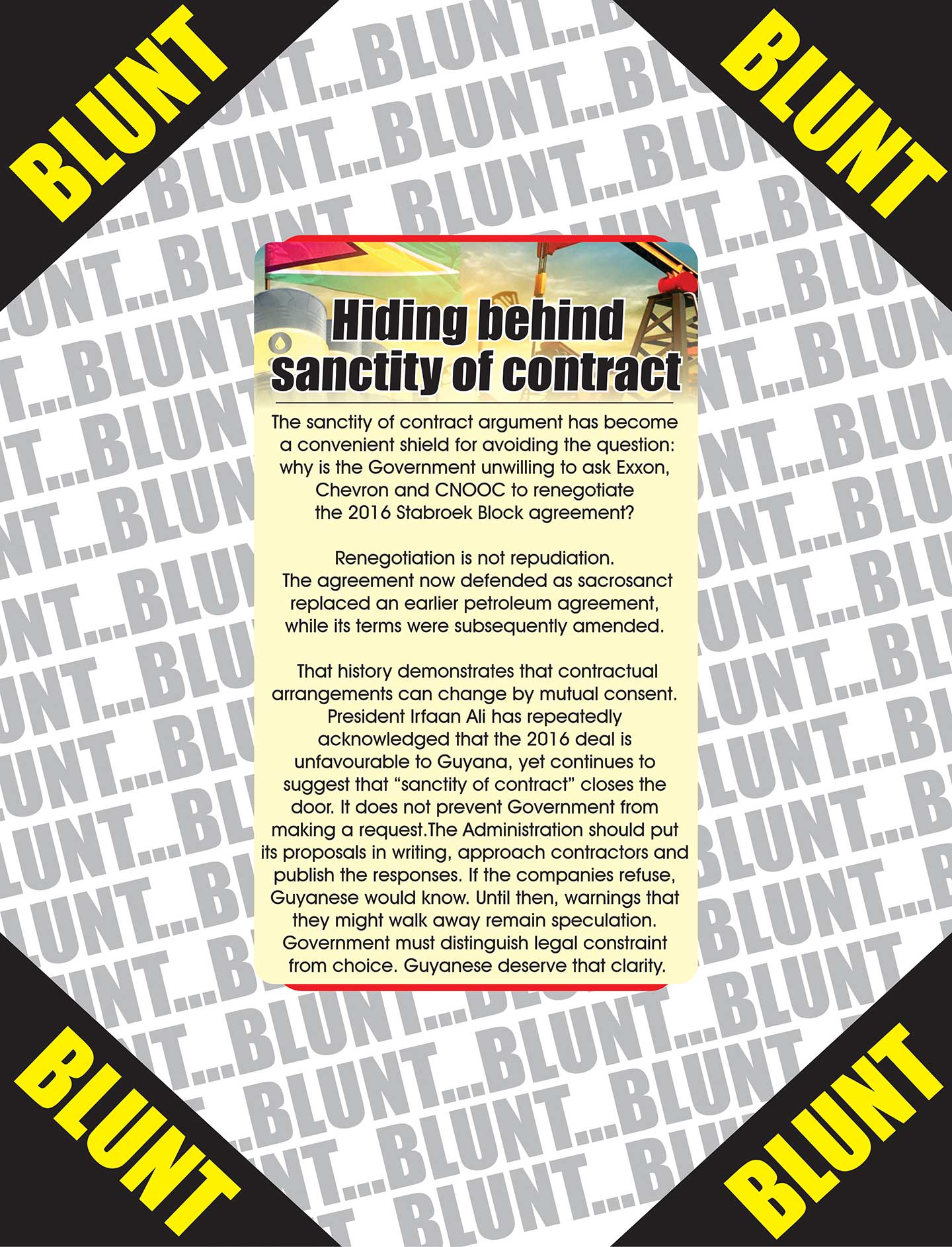
Blunt of the day
Sports

Features/Columnists

Sir. Ronald Sanders

The GHK Lall Column

Weekend Cartoon