Latest update October 17th, 2026 10:25 AM



Latest News
- Feasibility, EIA studies must be done for all project funded by US EXIM Bank – Ambassador
- Mohamed, staff granted $750,000 bail each for firearm, obstruction charges
- EU rallies in support of Ukraine amid Trump standoff
- Subcontractor electrocuted by live GPL wire
- Rodrigues-Birkett pushes multilateralism as path to ending global conflict
Website Hits

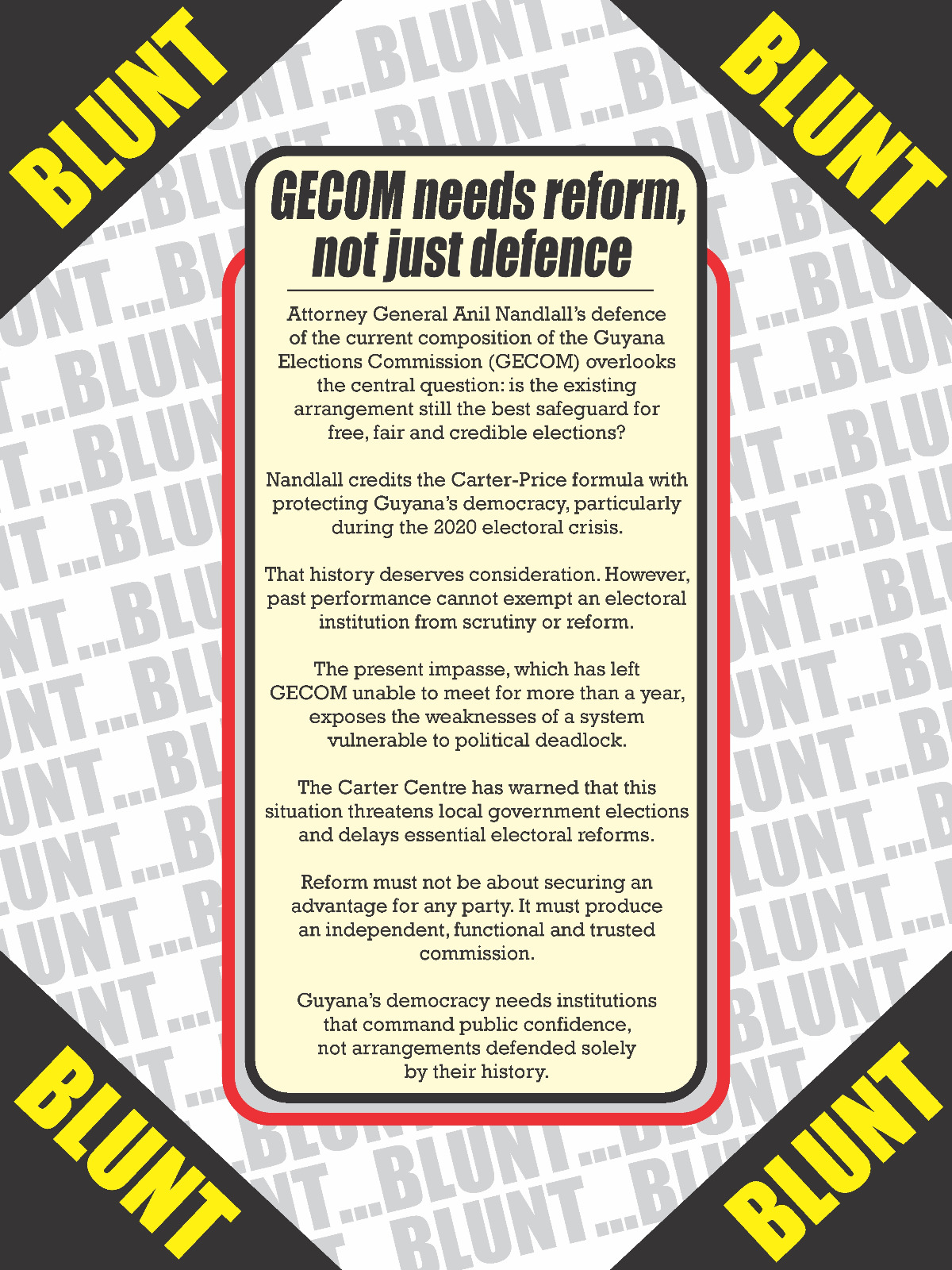
Blunt of the day
Sports

(Kaieteur News) – The Streetbike Championship will be decided in one last round on November 1 at the South Dakota Circuit. With just 14 points between the top three riders, the Caribbean Clash of...
Features/Columnists

(Kaieteur News) – My next question to Guru was done via mail. I wrote to him and asked Dear Guru, There is a problem that affects millions of people, yet many suffer through it in silence. It is heartbreak. People will openly discuss their financial difficulties, seek medical attention when...
Sir. Ronald Sanders

By Sir Ronald Sanders (Kaieteur News) – Who speaks for Haiti? It is a question the international community can no longer avoid. For years, governments and international organisations have insisted that the country’s deepening crisis must have a “Haitian-led solution”. The principle is...
The GHK Lall Column

(Kaieteur News) – It was Vice President Bharrat Jagdeo at his best. Mellowness amid a moment of mourning. A figure and contributor at his most solemn in an hour of reflection to honor the passing of Robert H. O. Corbin, Esq, MP, Deputy Prime Minister, and Opposition Leader. Let there be no...
Weekend Cartoon


WHY ARE WE POOR?
Feb 08, 2021 Features / Columnists, Front Page Comment
Kaieteur News-The difference between those poor and rich nations is not the age of the nation.
This can be demonstrated by countries like India and Egypt, which are far more than 2,000 years old and are still poor countries.
On the other hand, Canada, Australia and New Zealand, which 150 years back were insignificant, today are developed and rich countries.
The difference between the poor and rich nation does not also depend on the available natural resources.
Japan has limited territory, 80% mountainous, unsuitable for residence, agriculture or farming, but is the world’s third largest economy. The country is like an immense floating factory, importing raw materials from across the whole world and exporting manufactured products.
Switzerland: Switzerland is unable to grow cocoa, yet produces the world’s best chocolate. In its small territory, Switzerland rears animals and cultivates the land only for four months in a year, nevertheless manufactures the best milk products; a small country which is an image of security that has made it the strongest banking system in the world.
Another example is Korea. It doesn’t have oil but having the world’s largest refinery, it exports refined petroleum.
It has no grain of ore, and yet, it’s the world’s largest shipbuilder.
It has no copper but it’s the world’s most electrically and electronically wired country.
Executives from rich countries who interact with their counterparts from poor countries show no significant intellectual differences.
The racial or colour factors also do not evince importance: many migrants are heavy in laziness in their countries of origin, but are forcefully productive in rich European countries.
What then is the difference?
The difference is the attitude of the people, moulded for many years by education, moral responsibility and culture.
If you analyse the conduct of the people from the rich and developed countries, it is observed that a majority abide by the following principles of life:
1. Ethical behaviour as a basic principle.
2. Integrity.
3. Responsibility.
4. The respect for Laws and Regulations.
5. Respect by the majority of citizens towards others/Democracy.
6. The love of work.
7. The effort to save and invest.
8. The will to be productive.
9. Punctuality.
In the poor countries, a small minority follow these basic principles in their daily life.
We are not poor because we lack natural resources or because nature was cruel towards us.
We are poor because we lack attitude. We lack the will to follow and teach these principles of working like that of the rich and developed societies.
WE ARE IN THIS STATE BECAUSE…WE WANT TO TAKE ADVANTAGE OF OVER EVERYTHING AND EVERYONE.
WE ARE IN THIS STATE BECAUSE WHEN SOMETHING IS DONE WRONG, WE SAY – “LET IT BE” WHEREAS WE SHOULD HAVE A SPIRITED MEMORY AND ATTITUDE.
ONLY THEN WILL WE BE ABLE TO CHANGE OUR PRESENT STATE.
Share this:
Discover more from Kaieteur News
Subscribe to get the latest posts sent to your email.
Similar Articles