Latest update September 21st, 2026 10:57 AM


Latest News
- Defense accuses Police of misrepresenting court testimony, Magistrate says court unfazed by media
- Mohamed alleges political hand behind review of Justice Persaud’s U.S. visa
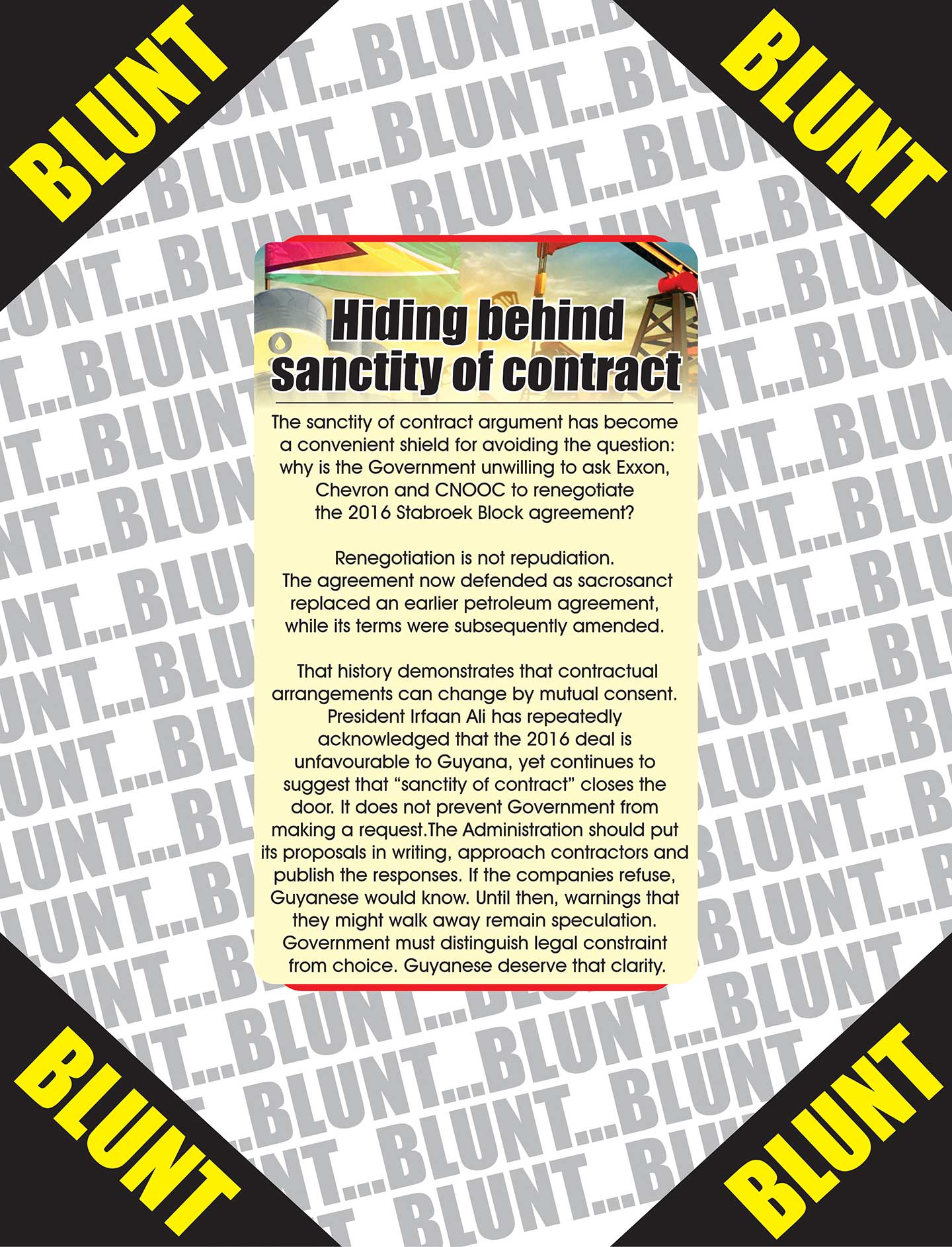
- ‘Stop blaming ‘sanctity of contract’ for keeping 2016 oil deal – Chris Ram tells Pres. Ali
- Iran and U.S. trade threats after Houthi attacks escalate regional conflict
- LIAT flight turns back to CJIA after engine issue
Tackling Agro-poison Suicides
 DEAR EDITOR,
Public Health Minister Volda Lawrence has been quoted in the local media as stating that “investigations ought to be conducted in suicide deaths caused by the intake of pesticides or other toxic chemicals, to ascertain whether safety and best practices were breached.”
May we remind the Minister that in early 2015, The Caribbean Voice (TCV) and a number of other stakeholders had met with the Pesticides and Toxic Chemicals Control Board (PTCCB) and an agreement arrived at that the PTCCB would unveil an adaptation of the Shri Lankan Model later that year. Nothing has since been heard about that unveiling.
The Shri Lankan model encompasses:
1. Introducing a minimum agro-chemicals list restricting the use of pesticides to a smaller number of pesticides least dangerous to humans.
2. Placing import restrictions to ensure that more dangerous chemicals do not enter the country.
3. Restricting the availability of agro-chemicals by ensuring they are stored safely in locked boxes in rural households, along with all equipment with which these pesticides are used.
4. Ensuring that empty containers are safely and effectively disposed of.
5. Restricting sale of agro-chemicals only to licensed premises and to licensed farmers.
6. Implementing administrative controls to ensure that sales outlets safely store all agro-chemicals.
7. Implementing an ongoing safe use policy to educate people about safe handling, use, storage and disposal. Concurrently, for small-scale farming, non-chemical methods, including organic farming, should be encouraged.
8. Improving medical management of pesticide poisoning: an important facet of control because better management will reduce the number of deaths. Requirements are the better availability of antidotes (both in central referral hospitals and ideally in peripheral health units) and ventilation facilities, better training, and better evidence for interventions.
9. Constantly monitoring all measures to ensure ongoing conformity, including random home visits to check for locked box storage and field visits to ensure that only licensed premises and licensed farmers have access to chemicals and that safe handling, use, storage and disposal are in effect.
In this context, the policy of sharing out cabinets to farmers makes sense. However, given that there are tens of thousands of farmers in Guyana, the few hundreds cabinets, doled out so far, is simply a band-aid approach, thus time for government to reach out to the World Health Organization and other potential international and local partners to come up with an effective, long term plan to tackle agro-poisons suicide.
This plan must, of necessity, include a widely publicised list of all banned agro chemicals. Additionally, potent agro-poisons such as gramoxone, the choice of poison in Guyana, must be added to that list. Gramoxone contains the lethal ingredient paraquat a substance banned in many nations across the globe. There is no known antidote and it has one of the highest death rates for poisons once ingested. While there has been no study on its usage in Guyana, a 1997 study by Dr. Daisley and Dr. Simmons on forensic analysis of acute poisonings in south Trinidad showed that of 105 deaths analysed, almost 95 per cent were cases of suicide, and almost 80 per cent of deaths were due to paraquat. An analysis of international literature, especially a study in South Korea, shows that the introduction of national policies regulating and banning paraquat led to a significant decrease in pesticide-associated mortality. Yet access to this poison in Guyana is as easy as access to candy. And, considering that those who attempt suicide generally do not want to die, ingestion of gramoxone effectively takes away from them that option to survive.
As well, at the Second Caribbean Regional Symposium on Suicide held in December 2015 in the Cayman Islands, a representative from the government spoke with UWI’s toxicologist and founder/head of UWI’s poison control centre, Dr. Verrol Simmons, and indicated to him that the Guyana government would employ his services in addressing agro-poisons suicides. At the third symposium in Trinidad & Tobago, Dr. Simmons disclosed to TCV that he never heard back from that individual or the government.
Dr. Simmons also indicated that once a person ingests poison, critical first steps can be taken right there and then to start the life saving process. There is no doubt that such information is desperately needed in Guyana for training and for nationwide dissemination.
As well, Dr. Simmons can provide technical and other assistance with respect to the poison control centers, which were supposed to have been established in mid 2016, according to a January 2016 disclosure in the media by Dr. Shamdeo Persaud. To date no such center has ever been set up.
The combination of an adaptation of the Shri Lankan Model and training by Dr. Simmons, even without the poison control centers, can ensure that there are no gaps and that in the mid to long-term agro-poisons suicides would be significantly reduced if not eliminated.
Sincerely
The Caribbean Voice
Share this:

Discover more from Kaieteur News
Subscribe to get the latest posts sent to your email.
Similar Articles
Website Hits

Blunt of the day
Sports
Features/Columnists

Sir. Ronald Sanders

The GHK Lall Column
Weekend Cartoon