Latest update July 31st, 2026 12:35 AM



Latest News
- Bloomberg reports: Oil curse hanging over Guyana’s head
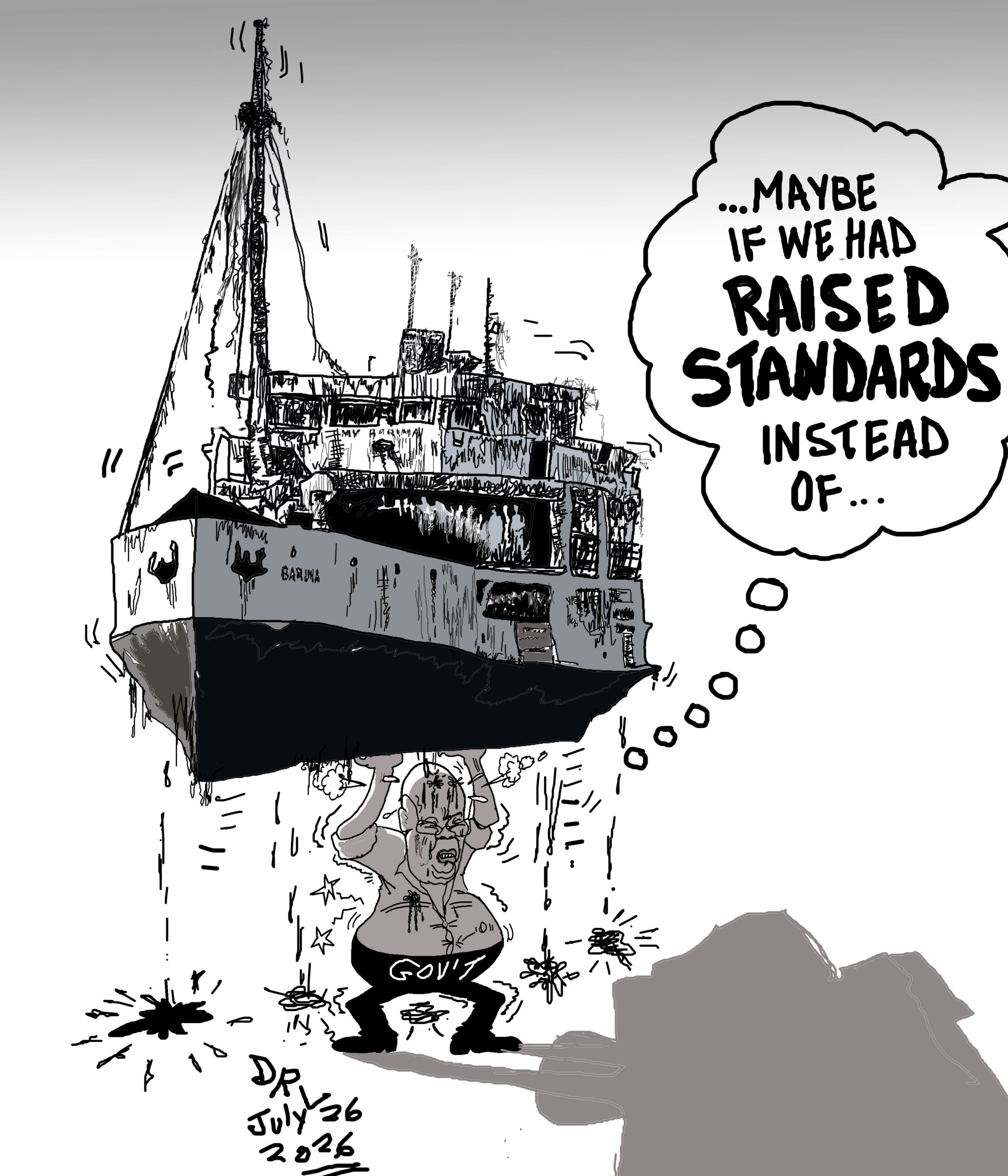
- ‘You can’t have both’ …Todd challenges parallel COI, murder prosecution of MV Barima crew
- Pres. Ali dodges media
- ‘Seaworthiness of MV Barima was MARAD’s responsibility, not charged crew’s’ – Dr. Todd
- ExxonMobil to conclude another exploration well next month
The nation needs a report on the outcome of the Caricom Heads of Govt. meeting
 DEAR EDITOR,
The past week has been a relatively disappointing one for representatives of the security sector at the national and regional levels.
Just before the commencement of the 40th Regular Meeting of CARICOM Heads of Government in St. Lucia, and just after its conclusion, law enforcement agencies across the region, but more particularly in Guyana, Trinidad and Tobago and Jamaica were grappling with serious security problems within their respective jurisdictions.
In Trinidad and Tobago, the business community was up in arms with the Minister of National Security and the Commissioner of Police over what they described as, “The freeness with which persons are able to kill in broad daylight, without fear of being apprehended.”
The business community’s concerns came in the wake of an escalating gang warfare that broke out on the twin-island republic compelling a former Minister in the Ministry of National Security to point out,
“It appears that the more money we spend on National Security with particular reference to crime solving the murder rate continues to escalate.”
The former Minister went on to add that, “It seems that throwing money alone in solving crime is not working.”
The matter came to a head when the T&T Commissioner of Police in an apparent fit of frustration, publicly declared, “Somebody has to bell the cat and that somebody has to be the Minister of National Security in collaboration with the Commissioner of Police and the Attorney General to get this thing done.”
The Minister’s remarks struck a familiar note reflecting a universally recognised deficiency in law enforcement, the paucity of intelligence sharing among and between law enforcement agencies tasked with fighting crime in its various manifestations.
And the “Thing” the Minister was referring to “get done” appeared to be the high level of gun crimes coupled with gang warfare lasting several weeks on the island.
Meanwhile, in Jamaica, a shake up in the high command of the Jamaica Police Force was announced.
Several newly appointed commanders were dispatched to take charge of three troubled divisions replacing eight gazetted officers who were transferred and reassigned.
With 675 murders across the island, beginning from January 2019, four more than the 671 over the corresponding period in 2018, murders amounted to almost 4 murders per day with gun crimes being the most prevalent.
In the wake of this troubling situation, the Prime Minister of Jamaica on his return from St. Lucia acted swiftly.
He declared a state of emergency in the Police Division of St. Andrew South where, according to the Prime Minister, “The main cause of death was caused by gangs.”
Similar States of Emergency exist in three western parishes of Jamaica, namely Westmoreland, Hanover and St. James.
St. Andrews South was the fourth parish to be so declared.
Over in Guyana, law enforcement agencies were experiencing their share of challenges.
In the midst of celebrations marking 180 years of the Guyana Police Force and the claim that the Force is surmounting its challenges, the narrative seemed to point in a different direction.
A Deputy Commissioner and Head of the Criminal Investigation Department (CID) of the Guyana Police Force was sent on administrative leave to make way for an investigation into allegations of misconduct and corruption against him.
The Head of the Serious Organised Crime Unit (SOCU) of the GPF was sent on administrative leave following publication of an audit report implicating him in a series wrong doings. Unconfirmed reports claim that it is unlikely his contract will be renewed.
In the midst of allegations over the wholesale of pillaging of assets of the Guyana Sugar Corporation (GUYSUCO), news broke that an undisclosed cache of arms and ammunition belonging to the Sugar Corporation was seized and lodged at a civilian outfit. Questions have been raised whether the civilian outfit is licensed to hold such a large quantity of arms and ammunition.
A prominent gay rights activist was physically assaulted and a nurse employed with the Ministry of Health was found hanging in her room at the nurse’s quarters where she lived while a young man was found dead in the lock ups of a police station on the Essequibo Coast.
And as though this was not enough, a member of the Presidential Guard was found unconscious lying on a city roadway with head injuries.
Later in the same week, an ex-police rank was arrested after being found in possession of over 200 lbs. of marijuana.
But there were much bigger issues on hand for the police to address. These included allegations of government facilitating a people-smuggling ring in which police ranks were allegedly involved.
And Roger Khan’s much anticipated release from incarceration and deportation to Guyana from the USA has been met with a deafening silence on the part of government and the police.
A tour of the horizon across the CARICOM region would show that fundamentally, the challenges to law enforcement in each jurisdiction have a lot in common.
It was for this reason, and the perennial reoccurrence of crime and security challenges that the twin social phenomenon continue to feature prominently on the agenda of the meeting of Caricom Heads.
Growing concerns by Heads of Government over the increasing challenges and potentially destabilising effects of crime and security gave rise to the convening of several special ministerial meetings of the Council for National Security and Law Enforcement (CONSLE) and summits of Heads of Government to address the problem.
The creation of the Implementing Agency for Crime and Security (IMPACS) and the Regional Intelligence Fusion Center (RIFC), among other regional security initiatives, were steps in the right direction.
However, failure by some member states to contribute financially, particularly to IMPACS, largely viewed by some Heads as a waste of money, resulted in the undermining of IMPAC’S mandate and, in many instances, the under-utilization of its staff of highly qualified, experienced and technically capable officers.
One member state’s representative went as far as to openly inform his colleagues at a meeting of Heads that his country got better results working with Scotland Yard and the FBI than working with IMPACS to address national security matters.
Further, It is to be recalled that the former Prime Minister of Trinidad and Tobago had advised her colleague Heads that her country would no longer be an ‘ATM’ to finance regional security projects outside of what was provided for under the Caribbean Basin Security Initiative (CBSI) and other bilateral agreements with friendly governments and external agencies.
Recently, we learnt from press reports that serious disagreements among Heads surfaced at the St. Lucia meeting as regards payment of annual contributions to IMPACS with governments coming under pressure to pay up their annual contributions while others are in arrears of their payments.
The St. Lucia Heads of the Government meeting ended like a damp squib in so far as regional security matters are concerned.
The signing of protocols amending the Revised Treaty of Chaguramas to incorporate CONSLE as a organ of the Community and IMPACS as an institution of the Community was long overdue.
And the wording in the Communique issued at the end of the summit was lukewarm on crime and security since all Heads did was to ‘agree to continue to strengthen the regional security architecture both at the institutional and personnel levels while acknowledging the role of and need to engage with international partners to this end.’
Undoubtedly, much more in this particular agenda item would have been discussed behind closed doors and in caucus that cannot be publicly disclosed, but the point that needs to be emphasized is that be that as it may, a Government of Guyana delegation attended the conference on behalf of all the people of Guyana yet there has been no report back to the nation as regards the outcome and benefits of the conference to Guyanese people.
The nation remains in the dark!
Yours faithfully,
Clement Rohee
Share this:

Discover more from Kaieteur News
Subscribe to get the latest posts sent to your email.
Similar Articles

Blunt of the day
Sports
Features/Columnists

Sir. Ronald Sanders

The GHK Lall Column

Weekend Cartoon