Latest update March 16th, 2026 12:30 AM

Mar 16, 2026 Features / Columnists, Peeping Tom
(Kaieteur News) – We are told that Guyanese, beginning with salaried public servants, will begin receiving the $100,000 cash grant this week. This is excellent news.
Nothing cheers the national spirit quite like the promise of free money, except perhaps the discovery that your neighbour’s fowl has wandered into your yard just at the same time you are boiling a pot of water. A cash grant, after all, is a case of government money travelling in the direction of citizens rather than the other way around.
Naturally, most people will accept that since the Budget has been passed, the funds have been lawfully appropriated, and therefore the government can now proceed to distribute the grant. Everything is neat, orderly, and constitutionally dressed.
But allow me to ask the sort of annoying question that usually gets you uninvited from polite dinner conversations: Why now?
You see, when the budget was first presented, the assumptions about oil prices were rather modest. At the time, crude was hovering around U.S.$65 per barrel, which in the volatile world of petroleum is considered almost shy. The calculations about revenue, spending, and cash grant were all built on the assumption of all prices hovering for some time around that level.
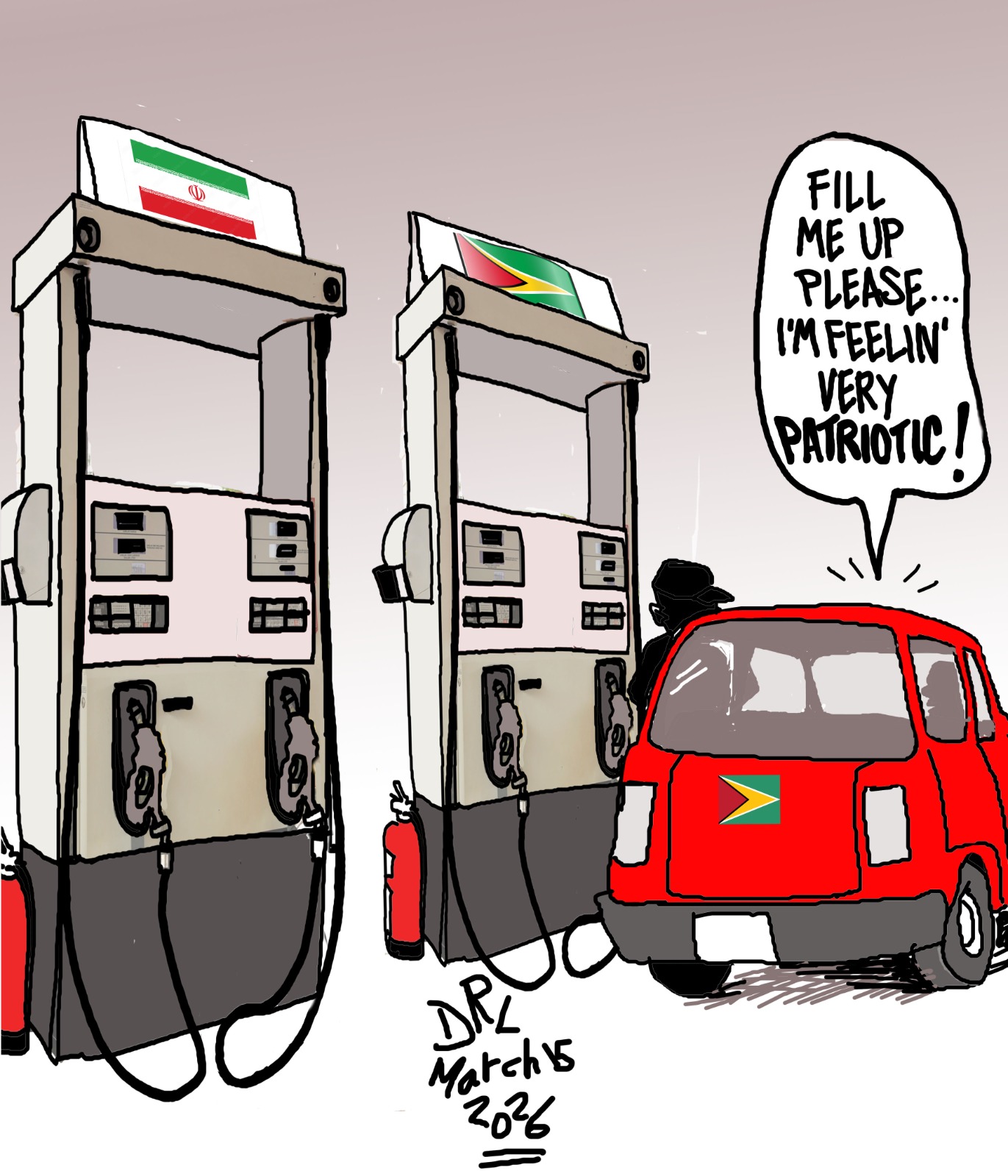
However, the world has since developed a habit of refusing to cooperate with tidy economic forecasts. Events in the Middle East have pushed oil prices to over U.S.$100 per barrel, and analysts are predicting they may climb even higher. In other words, the financial arithmetic that shaped the Budget has changed—and not slightly, but dramatically.
Now, I am no economist. But even I can see that when the price of oil jumps by more than fifty percent, the expected revenues for an oil-producing country tend to become rather… enthusiastic. Which raises an awkward but unavoidable thought.
If the original cash grant was $100,000 per adult based on oil at around U.S.$65, and oil is now flirting with U.S.$100 and above, wouldn’t the logical conclusion be that the grant itself should also grow? One could make a very respectable argument that the payment should now be $200,000 per adult. After all, the government is about to enjoy a substantial windfall from higher oil prices.
Of course, I am not suggesting anything improper. Governments are paragons of fiscal virtue. But one cannot help wondering whether the sudden urgency to distribute the grant right now has something to do with ensuring the payment is made before the oil windfall becomes too obvious to ignore.
Timing, as Shakespeare might have said if he had been a budget analyst, is everything. Yet the timing is not the only curious feature of this arrangement. The method of payment raises a few eyebrows of its own—particularly among those who still possess eyebrows.
The government has announced that the money will be deposited directly into citizens’ bank accounts. On paper, this sounds modern, efficient, and technologically enlightened. It also sounds like something invented in a conference room where everyone assumed that all Guyanese possess bank accounts, credit cards, and perhaps a modest investment portfolio in Swiss francs. Unfortunately, reality is slightly less elegant.
There are tens of thousands of Guyanese who do not have bank accounts. Some never felt the need to open one because interest rates are so low that saving money feels like storing sugar in the rain. Then there are those, like some of our hinterland resident, who live nowhere near a bank. Others cannot meet the minimum requirements imposed by banks—those charming little rules that require you to already have minimum balances that exceed what the small man can hide under his mattress.
In other words, the people who could benefit the most from a cash grant may be the very ones who cannot receive it through the chosen system.
Meanwhile, there exists another group of people with bank accounts in Guyana: individuals who live comfortably abroad—in places like New York, Toronto, and Miami—but who maintain local accounts. For them, the process is quite simple. They register online, click a few buttons, and the money appears in their account faster than you can say “oil boom.”
The result is a rather strange form of financial inclusion. Tens of thousands of Guyanese living overseas may effortlessly receive the grant, while tens of thousands of poorer citizens living right here in Guyana—without bank accounts—could be left wondering how inclusion managed to exclude them. One might call it digital generosity with analog consequences.
And so, the situation leaves us with two questions that refuse to go away. First, if oil prices are soaring and revenues are about to surge, shouldn’t the grant itself reflect that reality? And second, if the grant is meant to benefit the people of Guyana, shouldn’t the system ensure that the poorest citizens can actually receive it?
These are not unreasonable questions. In fact, they are the kind of questions that tend to arise whenever large sums of money, oil revenues, and human ingenuity collide in the same national moment.
Still, the payments are beginning this week, and that is good news. In a world filled with economic uncertainty, geopolitical turmoil, and bank forms written in a language that appears to be ancient Sanskrit, a cash grant is something tangible.
The only mystery that remains is whether, given the new oil reality, that grant should have been twice as large and whether the people who need it most will actually get it.
But perhaps that is a philosophical issue best discussed after everyone checks their bank account.
(The views expressed in this article are those of the author and do not necessarily reflect the opinions of this newspaper.)
Subscribe to get the latest posts sent to your email.
Your children are starving, and you giving away their food to an already fat pussycat.
Mar 16, 2026
Kaieteur Sports – Competitive football action returned to the East Bank corridor after a long hiatus when the inaugural East Bank Inter Village Competition kicked off at the Eccles EE Ground on...Mar 16, 2026
(Kaieteur News) – We are told that Guyanese, beginning with salaried public servants, will begin receiving the $100,000 cash grant this week. This is excellent news. Nothing cheers the national spirit quite like the promise of free money, except perhaps the discovery that your neighbour’s fowl...Mar 15, 2026
By Sir Ronald Sanders (Kaieteur News) – Amid the current turmoil in the world, it is important that, in the Americas, we should not forget the urgent humanitarian and political crisis confronting the Haitian people. For many years, the United States has been the principal destination for...Mar 16, 2026
From Shakespeare’s lament in Cymbeline: Fear no more the heat o’ the sun, Nor the furious winter’s rages; Though thy worldly task hast done, Home art gone, and ta’en thy wages; Golden lads and girls, all must, Like chimney sweepers, come to dust (Kaieteur News) – The life and times of...Freedom of speech is our core value at Kaieteur News. If the letter/e-mail you sent was not published, and you believe that its contents were not libellous, let us know, please contact us by phone or email.
Feel free to send us your comments and/or criticisms.
Contact: 624-6456; 225-8452; 225-8458; 225-8463; 225-8465; 225-8473 or 225-8491.
Or by Email: glennlall2000@gmail.com / kaieteurnews@yahoo.com